
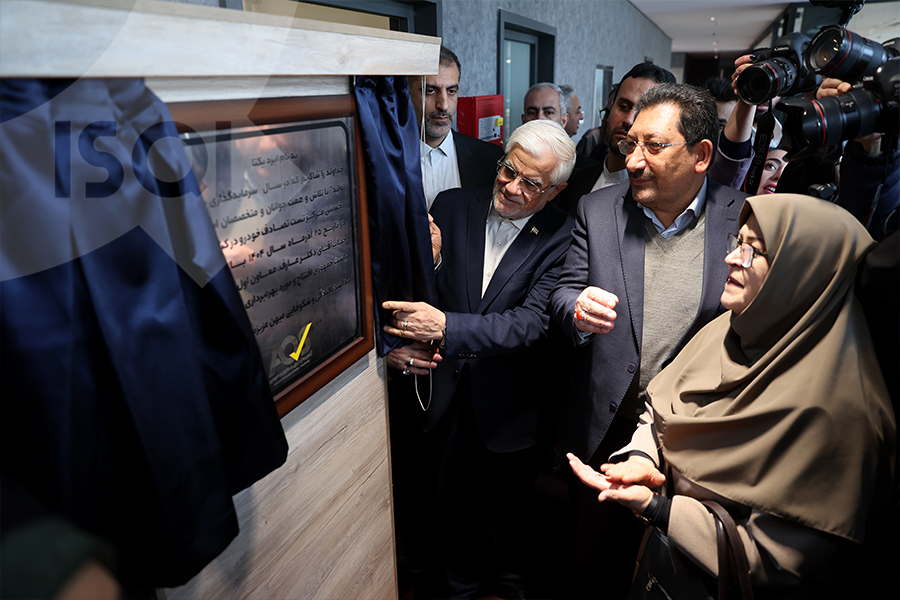
December 16, 2025, marks a pivotal date in the history of the country’s transportation industry and safety as first specialized vehicle iran crash test and safety evaluation center was inaugurated.
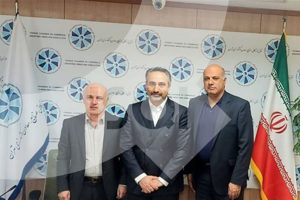
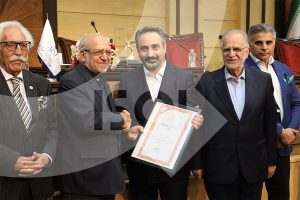
This national event, which was accompanied by a wide invitation of experts and industry activists, was held with the presence of Dr. Aref, the Honorable First Vice President, the Minister of Industry, Mine and Trade, the Minister of Roads and Urban Development, the Chief of the Traffic Police of the Disciplinary Force, the Head of the National Standards Organization, along with a group of senior government officials, shareholders, and automotive industry managers, who introduced this opening as a turning point in the government’s commitment to raising safety standards and aligning with global regulations.
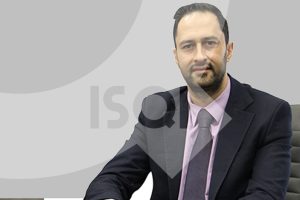
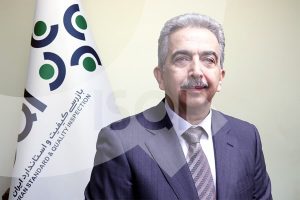
Saeed Tajik, CEO of Iran Inspection and Quality Standard Company, said: “The establishment of this center can play a significant role in advancing and improving the quality of cars and reducing casualties caused by road accidents in the country.” He continued: “The main goal of opening this center was to improve the quality and safety of cars in order to improve the welfare of society, which is free from a profit-making perspective, and for the next five years, any profit from this center will be spent on improving equipment and the safety of society.”
At the ceremony, Sardar Hosseini, Chief of the Traffic Police of the Disciplinary Force, stated: “At the beginning of the government, a promise was made to set up a specialized center in the field of allocating foreign currency to cars, and today, with an accurate understanding of the issue, we are witnessing the opening of this important center.”
He further appreciated the efforts of Dr. Tajik and his strong team, saying: “This team, with seriousness and sensitivity, has brought this center to its current stage, which will play a significant role in reducing accidents and preventing their complications. The importance of this center as the first iran crash test center is undeniable.”
Sardar Teymour Hosseini emphasized in his statements: “More than 90 percent of accidents are due to human error, and we can by no means reduce this error to zero. Therefore, we must develop the automotive industry to the point where the design and manufacture of vehicles move towards preventing and minimizing injuries and deaths.”
He pointed out that “We must design vehicles in such a way that they both reduce the risk before an accident occurs and prevent harm to passengers after it occurs. This center can play an effective role in improving the performance of passive safety systems and protecting the lives of drivers and passengers after an accident.”
Sardar Hosseini also praised Dr. Ansari and added: “We are planning to sign a memorandum of understanding that covers part of the 85 flowcharts and make the necessary changes so that we can repair and correct the current situation.”
He concluded by emphasizing the importance of dependence on up-to-date technology and stressed the need for cooperation between various institutions to improve road safety and reduce traffic accidents.
Farzaneh Ansari, head of the National Standards Organization, at the opening ceremony of the iran crash test center, clearly demonstrated the importance of this center and its achievements for improving the quality and safety of vehicles.
She called this day a turning point for the National Standards Organization and emphasized: “The Standards Organization has correctly formulated laws and regulations in line with the needs of the country and creates legal frameworks. Also, all the organization’s activities are ultimately defined to improve quality and safety, and we must make our activities stronger and more in line with the needs of society.”
The head of the National Standards Organization also added that ensuring complete vehicle safety is not limited to regulations and requires a precise and organized program. With the establishment of this center, there is no longer a need to send vehicles abroad for testing, which saves time and costs.
Ansari then referred to the vehicle safety situation in Iran and said: “We are moving toward better standards and will make some requirements mandatory.” He reminded that currently 58 standards have been made mandatory and they are aiming to raise that to 122 standards. He also noted that these serious policies reflect the National Standards Organization’s firm determination to improve the safety and quality of vehicles in Iran. Farzaneh Sadegh, Minister of Roads and Urban Development, also emphasized the government’s role as a facilitator for the private sector in her remarks and expressed pleasure at being among those who established this center through the tireless efforts of the private sector. She said: “The opening of this center is not just a project but a milestone in the pursuit of safety and the preservation of human life. Road accidents are a serious challenge that affect public health, the national economy, and social stability.” The minister also referred to the Seventh Development Plan law, which mandates a 10 percent reduction in road fatalities, and stressed: “This center is a major step in implementing this operational program and will address the existing deficiencies in the country’s safety governance system that have hindered effective oversight.” Seyed Mohammad Atabak, Minister of Industry, Mine and Trade, also remarked at the ceremony on the importance of vehicle and road safety, saying: “This issue is not merely industrial or technical; it holds particular significance as a matter of public reassurance for the government.” He added: “The problems within this framework require careful regulatory adjustments. The most important development has been that the Ministry of Industry, Mine and Trade, in cooperation with the National Standards Organization and the private sector, has drafted the vehicle quality regulations.”
Mohammad Reza Aref, the country’s First Vice President, referring to the achievement of producing a national car since 1979, said: “Although the missing link in the automotive chain is quality, fortunately, this issue has been given special attention in higher-level documents, especially in the Seventh Development Plan.” He emphasized: “In the 14th government, moving from origin to destination with the aim of preserving the lives of citizens is a fundamental strategy.”
Aref, pointing to the high number of fatalities resulting from accidents, raised the demand for increased quality in the automotive industry, saying: “We must move seriously in the direction of quality, and I thank the efforts of the private sector. Our hand is open for cooperation with the private sector, but we must not allow automakers to enter the market without following the necessary procedures and with special regulations.”
The First Vice President concluded by emphasizing culture-building and responsibility in the transportation industry, calling for a reduction in accidents and the preservation of people’s safety.
The newly established vehicle iran crash test center has the capability to perform most international tests, including standards R94, R95, R32, R34, R12, and R137. These capabilities, along with the use of advanced equipment certified by Euro-NCAP, enable the performance of extra-regulatory tests according to NCAP standards and contribute to the flourishing of Iran’s entry into advanced global standards. Crash tests, which are designed and implemented to protect the lives of passengers, include “full frontal impact,” “impact with low and medium overlap,” “side impact,” “pole impact,” “rear impact,” and “rollover tests.”
The diversity and quality of equipment in this center include the following main sections: – Test track with a length of 235 meters and a tolerance of one millimeter – Completely rigid impact block with manufacturing and installation tolerance of less than 0.5 mm in 4 meters – Powerful propulsion system capable of towing vehicles up to a mass of 3500 kg and speeds up to 110 km/h – Advanced calibration and performance control laboratory for dummies, manufactured by ACTS Germany – Utilization of various standard barriers in accordance with R32/34, R95, and Euro-NCAP (AEMDB) regulations, manufactured by ERNST Germany. These devices have brought the accuracy of tests closer to global standards. Also, the imaging systems of this center have the ability to record critical moments of impact with high accuracy, some of which include “NAC ultra-high-speed imaging system from Japan with the ability to record images from 1,000 to 100,000 frames per second,” “VISOL professional lighting tailored to the required features in ultra-high-speed imaging,” and “Advanced dummies manufactured by JASTI Japan, equipped with ENDEVCO USA sensors and MG-Sensor Germany.”
It is worth mentioning that the AQS center is only a crash test laboratory, and although it does not have the executive power to prevent or limit car production, it can help to correctly understand the behavior of cars in accidents and provide valuable assistance to legislators, supervisors, and manufacturers.
The main goal of this center is to help ensure the compliance of domestically produced and imported cars and to better monitor them with the most stringent safety requirements to protect the lives of passengers and pedestrians against traffic accidents. This center will act as a research hub, allowing Iranian engineers and designers to accelerate the research and development (R&D) process of cars domestically without the need to send samples abroad.
By localizing the testing process, we will see a significant reduction in production time and costs, which directly contributes to increasing the quality and competitiveness of Iranian products in regional markets. It is expected that with the full operation of this center, we will see a significant improvement in the safety ranking of domestically produced cars in the region.
The opening of the first iran crash test center is not only a national achievement but also a major social commitment. This vital infrastructure promises a safer future for Iranian drivers and families and is a major step towards transforming Iran into a safe automotive hub in the region.