

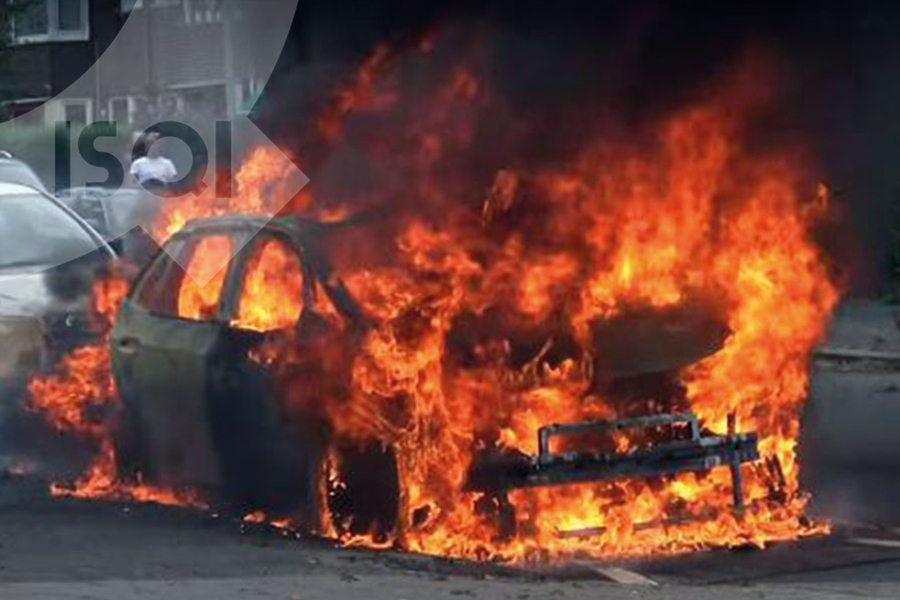
A research collaboration between the Fire Protection Research Foundation (FPRF) and the Fire Safety Research Institute (FSRI) has systematically tested a variety of tools and tactics for Electric Vehicle Fire response, with the intent of guiding fire departments on safer and more effective practices.
Scope of the Testing
About electric Vehicle Fire experiments were conducted using both battery modules (or packs) in isolation and complete EVs undergoing fire conditions.
The tests covered multiple response options, including standard hose streams (with and without additives), fire blankets designed for EVs, and specialized suppression devices and appliances.
Researchers evaluated effectiveness in extinguishing flames, avoiding re-ignition, controlling thermal runaway, and managing secondary hazards (e.g. gas release, explosion risk) under realistic conditions.
Key Findings and Observations:
Fire Blankets
Fire blankets can be effective in cutting off oxygen and suppressing flames.
However, a major drawback is that they can trap flammable gases generated during battery thermal runaway. If fresh air is later admitted, these gases may ignite or even explosively react.
In other words, while the blanket can smother the flames locally, it may create a hidden hazard by sealing in combustible byproducts.
Water Streams & Additives
Conventional hose streams remain part of the baseline approach, but with caveats: water must be applied in a controlled manner to avoid spreading burning material or causing electrical hazards.
Additives (e.g. foam agents or wetting agents) were tested to see whether they improve penetration, cooling, or suppression of re-ignition, though each additive also introduces its own tradeoffs.
The efficacy of water or water-agent mixtures depends heavily on how they’re applied (flow rate, angle, duration) and on the nature of the fire (degree of cell breach, presence of insulating layers, state of thermal runaway).
Specialized Devices & Tactics
Researchers looked into “targeted suppression appliances” designed to localize suppression to battery cells or modules without flooding the entire vehicle.
Tactics such as cooling adjacent, non-burning modules to prevent propagation of thermal runaway are also under evaluation, to act proactively rather than only reacting once full combustion occurs.
One challenge is balancing the need for aggressive cooling with the risk of structural or electrical damage, or introducing new pathways for oxygen or ignition.
Secondary Hazards & Re-Ignition
A recurring concern is re-ignition. EV battery fires can re-ignite after periods of apparent extinguishment, especially if internal cells are still hot or damaged.
Gas evolution (flammable, toxic, or pressurized gases) is a parallel hazard; containment methods (e.g. blankets) and ventilation strategies must consider how to safely release or manage those gases.
In some tests, gas buildup under a blanket caused sudden flare-ups when the blanket was moved or disturbed.
Implications & Next Steps
The research underscores that no single tactic is completely safe or universally applicable — each method has strengths and limitations depending on the fire scenario.
In Electric Vehicle Fire, fire departments must consider hybrid strategies: combining blanket suppression, directed cooling, and controlled water/agent streams in calibrated sequences.
Source: NFPA