

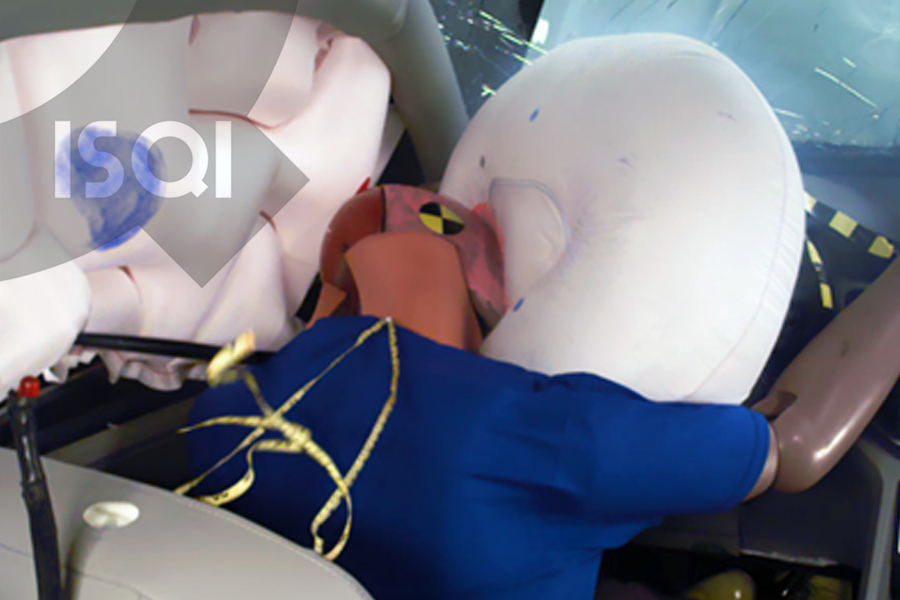
Researchers at the Insurance Institute for Highway Safety (IIHS) are expanding how crash test assess brain injury risk by adopting a new metric focused on rotational head motion—forces often missed by current testing methods.
Traditional crash test measures, like the Head Injury Criterion (HIC), quantify linear accelerations and are effective at predicting injuries such as skull fractures. But they are not designed to detect rotational or twisting forces on the brain—movements that occur when the head “whips” around after impact and which can lead to concussions or diffuse axonal injury.
Back in 2012, IIHS began adding rotational sensors to dummies and tried using the Brain Injury Criterion (BrIC) to interpret the data. However, when they applied BrIC to 150 small overlap and moderate overlap crash tests, they found it struggled to properly account for complex, multi-phase motion sequences—like a head hitting an airbag, sliding, then rebounding—treating them as if they occur simultaneously rather than sequentially.
To overcome these limitations, IIHS evaluated another metric—DAMAGE (Diffuse Axonal Multi-Axis General Evaluation)—which was originally developed for helmet safety and integrates both rotational acceleration and the timing/sequencing of head motions. DAMAGE is already used in helmet evaluations by the NFL and in vehicle safety ratings by the European NCAP since 2022.
Because IIHS uses both average-sized (50th percentile male) and smaller (5th percentile female) dummies in crash testing, the organization funded research to adjust DAMAGE’s brain strain thresholds so they better reflect smaller female anatomy.
Over roughly 800 dummy tests (frontal and side crashes), IIHS calculated DAMAGE scores and compared them to HIC and visual observation. In most cases, all three aligned—indicating the dummy’s head was adequately protected. But in about 60 of those tests, DAMAGE flagged potentially harmful head motions that HIC and visual inspection missed. This suggests DAMAGE can uncover hidden risks of rotational injury that conventional methods overlook.
Where damage scores were high, IIHS proposes practical mitigation ideas—such as a deeper frontal airbag that is softer in the middle to cradle the head like a “catcher’s mitt,” reducing deflection that leads to rotation.
While IIHS is not yet using DAMAGE to produce official safety ratings, it will begin calculating and publishing DAMAGE scores in its technical test reports starting this year. Meanwhile, automakers are encouraged to consider design changes now to reduce head-whipping motion in crashes.
Source: IIHS