

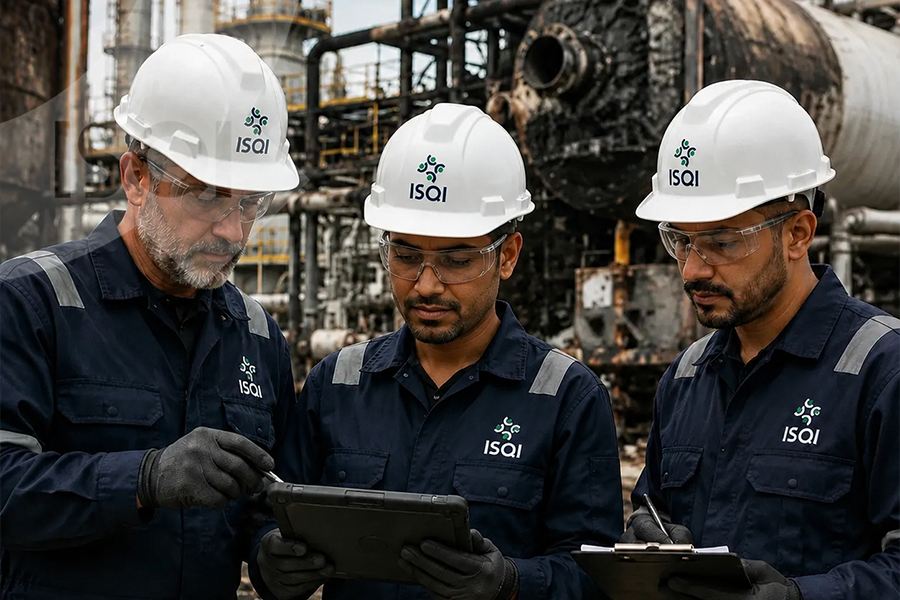
The oil and gas industry operates under conditions that involve high pressures, high temperatures, flammable substances, and complex processing equipment. Because of these characteristics, facilities are always exposed to potential incidents such as fires, explosions, hazardous material leaks, equipment failures, and mechanical accidents. Such incidents can cause serious damage to process equipment, pipelines, pressure vessels, and industrial structures. Therefore, conducting Post‑Incident Inspection is one of the most critical stages in safety management and recovery of industrial facilities. This type of inspection aims to evaluate the extent of damage, identify the root cause of the incident, determine whether equipment can continue operating safely, and prevent similar events in the future.
Post-incident inspection consists of a series of engineering, technical, and analytical activities carried out by specialized teams including inspection engineers, corrosion specialists, safety engineers, and metallurgical experts. This process usually begins after the incident has been fully controlled and the affected area has been secured. The first stage is initial safety assessment and stabilization of the incident site. At this stage, safety and inspection teams ensure that the environment is safe for investigators to enter and that secondary hazards such as gas leaks, reignition, or structural collapse are not present.
After the site is secured, the documentation and evidence collection stage begins. In this stage, photographs of the incident scene are taken, maps and layouts are reviewed, and the condition of damaged equipment is recorded carefully. Operational data such as pressure, temperature, process conditions, and maintenance records are also examined. These data are essential for analyzing the cause of the incident and evaluating the level of damage. In many cases, information recorded in process control systems such as DCS (Distributed Control Systems) and SCADA systems helps investigators understand how the incident developed.
The next step is visual technical inspection of the equipment. During this stage, inspectors look for signs such as deformation, cracks, burn marks, discoloration of metals, leakage, or mechanical damage. These observations can provide important clues about the severity of the incident and the type of damage experienced by the equipment. For example, discoloration of steel caused by heat exposure may indicate that the equipment was subjected to high temperatures during a fire.
Following the initial visual evaluation, Non‑Destructive Testing (NDT) methods are used to assess the damage more accurately. These techniques include Ultrasonic Testing (UT), Magnetic Particle Testing (MT), Liquid Penetrant Testing (PT), Industrial Radiography (RT), and Eddy Current Testing (ET). The purpose of these methods is to detect cracks, voids, wall‑thickness reduction, or other internal defects without damaging the equipment itself. In pipelines and pressure vessels, ultrasonic thickness measurement is one of the most important methods used to detect corrosion or structural weakening after an incident.
In many industrial incidents, equipment may be exposed to intense heat caused by fire. In such cases, examining the metallurgical properties of materials becomes extremely important. Metallurgical tests such as micro-structural examination, hardness testing, and chemical composition analysis may be conducted. These tests help determine whether the mechanical properties of the metal have changed. For example, steels exposed to high temperatures may experience loss of strength or changes in their metallurgical structure.
Another key stage in post‑incident technical inspection is Root Cause Analysis (RCA). At this stage, techniques such as Fault Tree Analysis (FTA), the Five Whys method, or cause‑and‑effect analysis are used to determine the primary cause of the incident. Identifying the root cause helps organizations implement corrective actions and prevent similar incidents from occurring again.
After completing inspections and testing, the inspection team performs a Fitness‑for‑Service (FFS) assessment. This evaluation determines whether the damaged equipment can continue operating safely or whether it requires repair, reinforcement, or replacement. Standards such as API 579 / ASME FFS‑1 are widely used to evaluate the integrity of damaged equipment. These standards provide detailed engineering procedures for analyzing stresses, cracks, and wall‑thickness loss.
Finally, the results of the inspection are compiled into a comprehensive technical report. This report typically includes a description of the incident, inspection methods used, test results, analysis of the incident causes, and technical recommendations for repair or equipment replacement. Such reports play a crucial role in improving safety management systems, maintenance programs, and operational decision‑making within the oil and gas industry.
Overall, post‑incident inspection is one of the most important tools for safety management in the oil and gas sector. Conducting this process carefully and scientifically not only helps restore damaged equipment safely to operation but also identifies risk factors and system weaknesses, thereby reducing the likelihood of future incidents and improving equipment reliability.
Sources:
- API Standard 579‑1/ASME FFS‑1. (2021). Fitness‑For‑Service. American Petroleum Institute & American Society of Mechanical Engineers.
- API Recommended Practice 571. (2020). Damage Mechanisms Affecting Fixed Equipment in the Refining Industry. American Petroleum Institute.
- Mobley, R. K. (2019). Maintenance Engineering Handbook. McGraw‑Hill Education.
- ASM International. (2018). ASM Handbook: Failure Analysis and Prevention. ASM International.
- CCPS (Center for Chemical Process Safety). (2011). Guidelines for Investigating Chemical Process Incidents. Wiley.
- Becht, C. (2009). Process Plant Equipment: Operation, Control, and Reliability. CRC Press.