

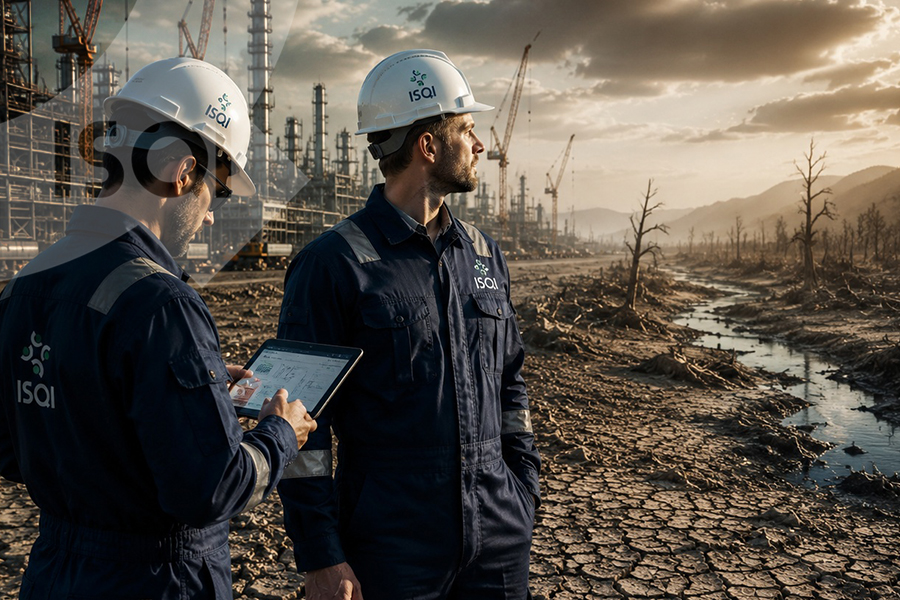
Over the past two centuries, the concept of “development” has become inseparably intertwined with economic growth and increases in Gross Domestic Product (GDP). However, in recent decades, the adverse consequences of this model of progress have confronted the world with a crisis that goes far beyond simple pollution: a phenomenon known as ecocide. The boundary between economic development and ecocide lies in a gray zone where short-term profitability conflicts with the planet’s long-term survival. This article examines the point at which development deviates from its constructive path and turns into a mechanism for the systematic destruction of life.
- Defining Economic Development in the Classical Paradigm
In the traditional view, economic development signifies the transition from traditional to modern economies, industrialization, and increased productivity. Within this model, nature is regarded as an “infinite resource” and a “free sink for waste.” Indicators of success are defined solely on the basis of financial flows, while the costs of ecosystem destruction are ignored in national accounting as “externalities.” This reductionist perspective constitutes the first step toward ecocide.
- Ecocide: Destruction Beyond Pollution
The term ecocide refers to the widespread, severe, and systematic destruction of ecosystems to such an extent that their vital services for inhabitants (human and non-human) are lost. Unlike localized pollution, ecocide implies irreversible changes—such as massive deforestation in the Amazon for cattle ranching, the destruction of wetlands for oil extraction, or ocean acidification caused by uncontrolled carbon emissions. At this stage, development no longer serves human welfare; rather, it undermines the very foundations of life.
- Where Is the Boundary?
To understand the boundary between these two concepts, environmental scientists have proposed the model of Planetary Boundaries. These boundaries include climate change, biodiversity loss, nitrogen cycles, and freshwater use.
– Sustainable development occurs when economic activities remain within the safe operating space defined by these boundaries.
– Ecocide begins when economic development—whether deliberately or negligently—crosses these biophysical thresholds and endangers the stability of global ecosystems.
In essence, the boundary between development and ecocide lies at the “point of irreversibility.” If resource extraction exceeds nature’s capacity for regeneration, development becomes a self-destructive process.
- The Political Economy of Ecocide
Many critics argue that the current structure of global capitalism inherently tends toward ecocide, since the demand for “unlimited growth on a finite planet” is physically impossible. Large corporations and governments often advance projects under labels such as “job creation” or “energy independence” that ultimately lead to the destruction of critical ecosystems. Here, political power acts as a catalyst that blurs the line between legitimate development and environmental crime.
- Criminalizing Ecocide: Guarding the Boundaries
In recent years, international movements have sought to recognize ecocide as the fifth international crime—alongside genocide and war crimes—under the jurisdiction of the International Criminal Court (ICC). The purpose of this legal initiative is to draw a moral and legal red line: development that results in widespread destruction of nature is no longer merely an economic choice but a “crime” against humanity and future generations. Such legislation could hold senior executives and policymakers accountable for decisions that lead to catastrophic environmental damage.
- Transitioning to Alternative Paradigms
To prevent collapse, the world must redefine the concept of development. Alternative models include:
– Doughnut Economics: Emphasizing the fulfillment of human needs within ecological limits.
– Circular Economy: Aiming to eliminate waste and maximize resource reuse.
– Degrowth: Advocating the deliberate reduction of production and consumption in developed countries to restore planetary balance.
Conclusion
The boundary between economic development and ecocide ultimately lies in how we understand the concept of “profit.” If profit is measured solely in financial terms, we will inevitably move toward ecocide. But if development is understood as enhancing quality of life, promoting equity, and preserving the planet’s biological integrity, we can step back from this dangerous threshold. The survival of human civilization depends on transitioning from an economy that requires the destruction of its home (Earth) for growth to one that operates in harmony with the laws of nature.
Author: Zahra Shirband – International Relations Expert ISQI
Source:
- Rockström, J., et al. (2009). Planetary Boundaries: Exploring the Safe Operating Space for Humanity. Ecology and Society.
- Higgins, P. (2010). Eradicating Ecocide: Laws and Governance to Stop the Destruction of the Planet. Shepheard-Walwyn.
- Raworth, K. (2017). Doughnut Economics: Seven Ways to Think Like a 21st-Century Economist. Chelsea Green Publishing.
- Sachs, J. D. (2015). The Age of Sustainable Development. Columbia University Press.
- Stop Ecocide Foundation (2021). Independent Expert Panel for the Legal Definition of Ecocide.
- Meadows, D. H., et al. (1972). The Limits to Growth. Club of Rome.