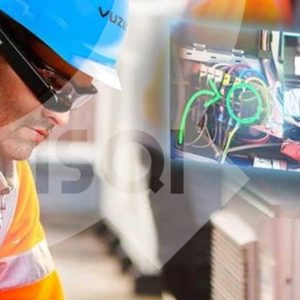

Overhaul, or major maintenance, is a strategic process in heavy industries such as oil and gas, power plants, and manufacturing. During this process, equipment is taken out of service in order to restore reliability and return it to its original design conditions. Unlike routine maintenance, overhaul is considered one of the most hazardous stages in the asset life cycle due to its intrusive nature, strict time constraints, high workforce density, and the simultaneous execution of multiple activities within confined areas and they must be continuously subjected to technical inspection and quality control.
During overhaul operations, certain protective and safety systems are often temporarily disabled to allow maintenance activities to proceed. Additionally, the opening of energy transfer lines, potential exposure to chemical or process materials, and changes in equipment configuration can create a more unstable work environment. Therefore, technical inspection in quality control during overhaul is not merely an engineering activity aimed at assessing component integrity; it also functions as a critical safety filter intended to prevent catastrophic incidents such as hazardous material leaks, explosions, and severe injuries. Successful overhaul operations require the simultaneous management of inspection safety and production continuity, with strict adherence to safety standards forming the backbone of execution.
Below are the key safety considerations for inspections conducted during overhaul, explained with reference to relevant standards.
- Personnel Preparation and Training
Before work begins, all personnel must be fully informed about safety requirements. Training should be provided on hazardous materials, safe work procedures, and appropriate responses during emergency situations.
- Personal Protective Equipment (PPE)
Personal protective equipment represents the final line of defense for inspectors.
Reference Standard: OSHA 1910.132 (General Requirements for Personal Protective Equipment).
Depending on the type of inspection, inspectors should use:
– Safety helmets
– Safety goggles
– Antistatic safety shoes
– Flame‑resistant clothing (FRC)
– Chemical‑resistant gloves
– Respiratory protection such as SCBA/SABA when required
- Workplace Safety
The work environment must be carefully assessed to identify potential hazards such as toxic chemicals, electrical shock risks, or dangerous equipment. Proper hazard identification and control measures should be implemented before inspections begin.
- Energy Control and Isolation
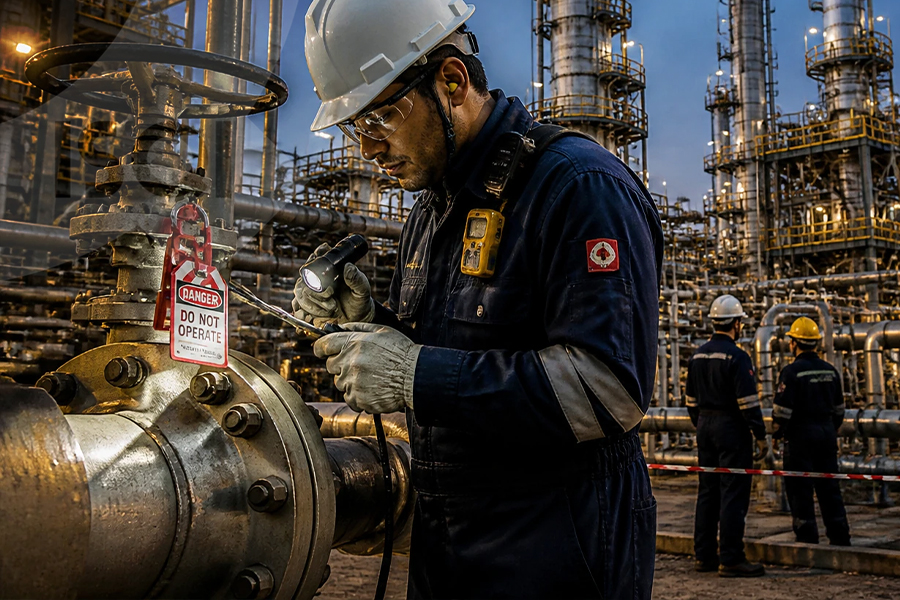
Before any technical inspection, quality control or maintenance activity, all energy sources (electrical, mechanical, hydraulic, and chemical) must be safely isolated.
Reference Standard: OSHA 29 CFR 1910.147 (Lockout/Tagout – LOTO).
This standard requires equipment to be isolated from all energy sources and secured using locks and tags to prevent accidental startup by other personnel during inspection. The release of stored or residual energy (for example, pressure in pipelines) is also essential.
- Confined Space Entry
Many overhaul inspections involve entering tanks, towers, or pressure vessels, which are classified as confined spaces.
Reference Standards: OSHA 29 CFR 1910.146 and API RP 2015 (Cleaning and Safety of Tanks).
Key requirements include:
– Atmospheric Testing: Before entry, the internal atmosphere must be tested for oxygen levels, flammable gases (LEL), and toxic gases such as H₂S by trained personnel.
– Ventilation: Mechanical ventilation systems must be used to maintain safe air quality.
– Attendant: A standby person must always remain outside the confined space to coordinate rescue operations if an incident occurs.
- Hazardous Materials and Toxic Gases
In the oil and gas industry, the presence of lethal gases such as hydrogen sulfide (H₂S) or carcinogenic substances like benzene presents serious risks.
Reference Standard: API RP 2219 (Safe Operation of Equipment Depressuring and Cleaning).
Inspectors should carry personal gas monitors. Prior to inspection, equipment must be completely purged, flushed, and decontaminated according to standard procedures to remove hazardous chemicals.
- Working at Height and Fall Protection
Many inspection points (such as the tops of columns or elevated tanks) require access at height.
Reference Standard: OSHA 1926 Subpart M (Fall Protection Standards).
Safety measures include:
– Using certified scaffolding compliant with OSHA 1926.451
– Wearing full-body harnesses and using lifelines
– Securing inspection tools to prevent falling
Tools used at height should be attached with lanyards to the inspector’s wrist or the structure.
- Safety in Inspection Methods (NDT Safety)
Inspection techniques themselves may introduce specific hazards.
– Radiation Safety (Radiographic Testing):
When radioactive sources such as Iridium‑192 or Cobalt‑60 are used, the technical inspection area must be clearly marked and isolated with warning signs to prevent personnel exposure.
Reference Standard: NRC 10 CFR Part 34.
– Electrical Safety:
Electrical NDT equipment used in areas with flammable gases must have Ex (explosion‑proof) certification.
Author: Zahra Shirband – International Relations Expert ISQI
Sources:
- OSHA (Occupational Safety and Health Administration) – https://www.osha.gov – Primary reference for workplace safety standards.
- API (American Petroleum Institute) – API Recommended Practices (RP), particularly the 2000 series related to refinery safety operations.
- ASNT (American Society for Nondestructive Testing) – Provides specialized safety guidelines for nondestructive testing.
- Internal HSE Manuals – Every oil and gas project should have a Site Safety Plan developed in accordance with the above standards.