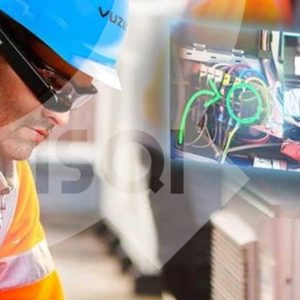

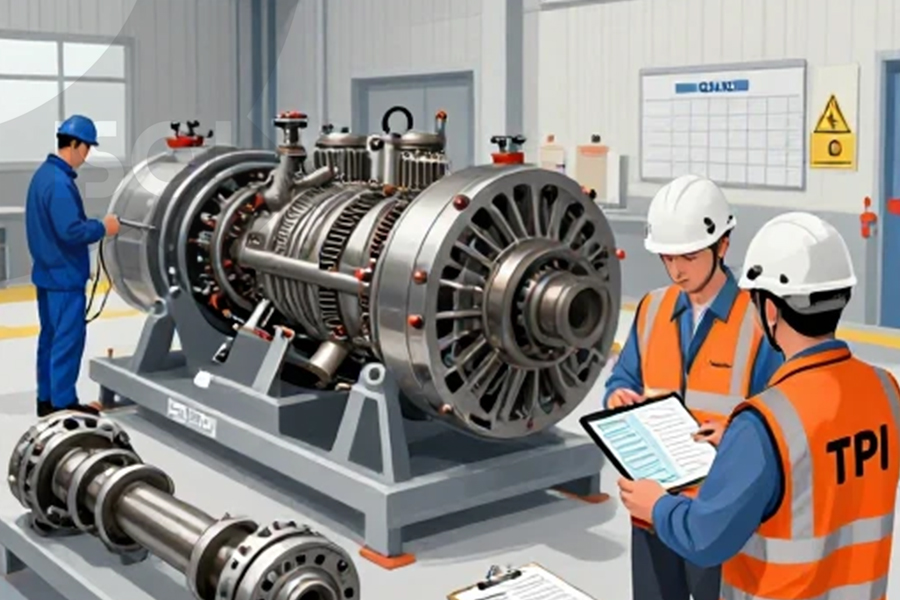
In‑process overhaul inspection comprises all monitoring and verification activities performed during the disassembly, repair, replacement, refurbishment, and reassembly of equipment. Its purpose is to ensure that every step is executed in accordance with technical standards, engineering drawings, and the manufacturer’s instructions. Unlike initial or final inspections, in‑process inspection focuses on real‑time quality control and preventing human errors or technical deviations while the work is being carried out.
In many industries – especially oil and gas, petrochemical, power generation, and steel – the overhaul process is technically complex and financially demanding. Any mistake during execution can lead to secondary failures, rework, significant schedule delays, or even cause equipment to fall below its required operational class. For this reason, in‑process inspection serves as the cornerstone of quality assurance in overhaul projects.
Inspection companies, acting as independent third‑party entities (Third‑Party Inspection—TPI), play a critical role in ensuring both the quality and impartiality of the overhaul process.
Major responsibilities
- Ensuring Transparency Between Client and Contractor
During overhaul projects, repair contractors may sometimes bypass certain standards to reduce time or cost. The presence of an independent inspection company ensures that all activities are traceable, verifiable, and conducted with controlled quality. - Enforcing International Standards and Manufacturer Requirements
Inspectors are responsible for verifying that all repair and overhaul processes comply with relevant API, ASME, ISO, EN, and OEM guidelines. This alignment significantly reduces the possibility of defects, operational risks, and costly rework. - Providing Independent Technical Judgment
When disagreements arise between the client and the contractor—for example, concerning whether a component requires replacement—the inspection company acts as a neutral technical authority, providing an unbiased and expert decision. - Overseeing the Entire Quality Assurance and Quality Control Framework
Inspection companies typically implement, supervise, and document QA/QC processes, including:
– Verification and validation of technical documents
– Planning inspection and testing activities
– Reviewing and approving repair procedures
– Assessing the competency of repair technicians and NDT Level II/III personnel
– Preparing and applying specialized inspection checklists
- Issuing Legally Defensible Inspection Reports
The final inspection report prepared by the inspection company is an official and legally traceable document. It includes detailed findings from the overhaul, identified defects, root causes, corrective actions, and the final quality status of control the equipment. In many industries, equipment cannot be returned to service without this report. - Reducing Operational Risk and Enhancing Safety
Independent oversight helps prevent errors that could lead to serious incidents, such as:
– Incorrect bearing assembly
– Misalignment during reassembly
– Undetected cracks on shafts or blades
– Use of non‑standard or non‑compliant spare parts
- Increasing Equipment Lifetime and Improving Reliability
Independent inspection ensures that repair activities are performed with genuine adherence to standards and technical requirements. This directly enhances equipment reliability and extends its operational life.
Author: Zahra Shirband – International Relations Expert ISQI
Sources:
– American Petroleum Institute (API), Standards 510, 570, 653, 610, and 686
– ASME Boiler & Pressure Vessel Code, Section V
– ISO 14224: Reliability and Maintenance Data Collection
– Maintenance Engineering Handbook, Lindley R. Higgins
– Machinery’s Handbook, Industrial Press
– Operational experiences and case studies published in IEEE and ASME journals related to rotating equipment maintenance.