

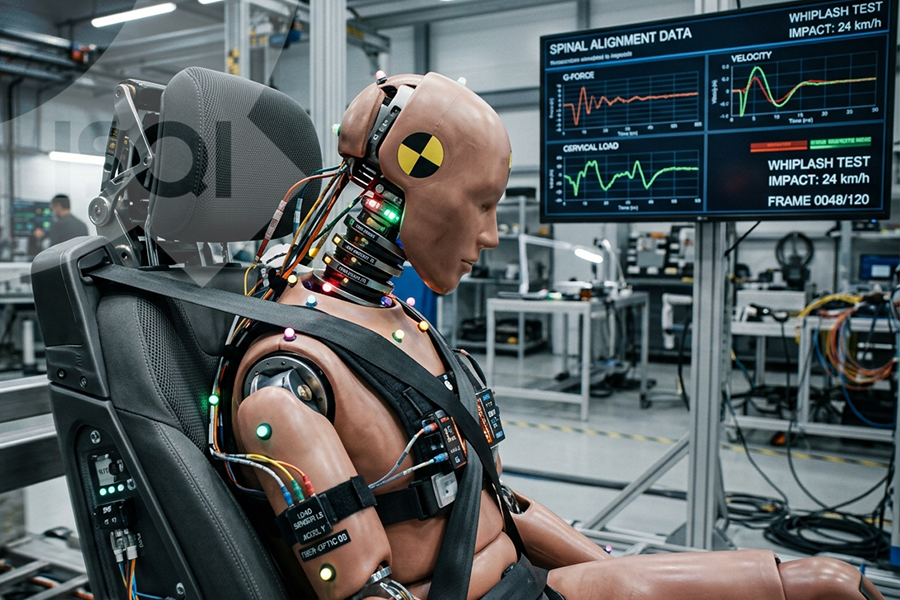
The Insurance Institute for Highway Safety (IIHS) has introduced a new test to evaluate how well vehicle seats and head restraints protect occupants from neck injuries. This test is specifically designed to assess protection in rear-end crashes. Early results show that out of 18 small SUVs tested, only four achieved a “good” rating—once again highlighting the importance of careful seat and head restraint design in reducing injuries caused by rear impacts.
According to IIHS, neck sprains and strains are among the most common injuries recorded in insurance claims related to vehicle crashes in the United States. IIHS President David Harkey emphasized that the goal of the new test is to push automakers to improve seat and head restraint designs so they provide better protection against forces that typically cause neck injuries. The test represents an effort to move beyond outdated standards and better reflect real-world rear-end crash conditions.
Why Was the Previous Test No Longer Sufficient?
Years ago, IIHS conducted a test to evaluate head restraints and neck protection using a simulated rear impact. Over time, as vehicle designs improved, nearly all new models began performing well in that test. As a result, the assessment lost its ability to meaningfully distinguish between vehicles and was discontinued in 2022.
However, real-world insurance data showed that neck injury problems had not been eliminated. Even occupants of vehicles that performed well in the old test were still experiencing whiplash injuries in actual crashes. At the same time, there were significant differences in insurance claims between different models—differences that the previous test could not accurately detect. This highlighted the need for a new, more precise evaluation method.
How the New Test Works
In the new IIHS procedure, the driver’s seat is removed from the vehicle and mounted on a sled system. A specialized crash-test dummy—designed to replicate the human body and assess rear-impact injuries—is then placed in the seat. The system applies a sudden acceleration to simulate a rear-end collision.
Unlike the previous test, which used a single severity level (equivalent to a rear impact at about 20 mph), the new method includes multiple crash severities. This allows researchers to capture more realistic seat and head restraint behavior under different conditions.
IIHS tested seats from 36 new vehicles across multiple conditions and compared the results with real-world insurance claim data. The findings showed that certain metrics at 20 and 30 mph were most strongly associated with injury risk.
What Do the Evaluation Criteria Measure?
The new assessment uses multiple technical indicators rather than relying on a single metric.
One key factor is the time to head-to-head restraint contact, which measures how quickly the occupant’s head contacts the head restraint. A shorter time generally indicates better protection.
Another metric is the acceleration of the T1 vertebra, located at the base of the neck where it connects to the upper torso. This measurement is important for understanding how forces are transferred through the spine.
Pelvic displacement is also evaluated. This indicates how effectively the seat absorbs crash energy and prevents excessive forward body motion. Ideally, the occupant should sink into the seat in a controlled way, reducing sudden head and neck movement.
In addition, neck bending moment is measured, which reflects forces that cause the head to flex forward or backward. An effective head restraint should keep the head aligned and stable with the spine, minimizing abrupt motion.
Marcy Edwards, IIHS senior research engineer and developer of the new evaluation, stated:
“We still do not fully understand the exact mechanisms that cause whiplash injuries, but evidence shows that reducing these motions and forces can help reduce injuries in real-world crashes.”
Initial Results: Significant Differences Between Vehicles
The first phase of testing revealed wide variation in performance. Out of 18 small SUVs evaluated, only four models—Audi Q3, Hyundai Ioniq 5, Subaru Forester, and Toyota RAV4—earned a “good” rating.
Nine models were rated “acceptable”: Buick Encore GX, Chevrolet Equinox, Honda CR-V, Jeep Compass, Kia Sportage, Mercedes-Benz GLB-Class, Mitsubishi Outlander, Volkswagen Taos, and Volvo XC40.
Two vehicles—BMW X1 and Nissan Rogue—were rated “marginal,” while Ford Bronco Sport, Hyundai Tucson, and Mazda CX-50 received the lowest “poor” rating.
Most tested models were 2025 model-year vehicles, except the 2024 Honda CR-V. These ratings will remain valid for many models through 2026.
What Differentiates Good and Poor Performers?
According to IIHS, vehicles rated “poor” performed inadequately across all three main evaluation areas: head and spine support, head-to-head restraint interaction, and seat energy management. These vehicles showed serious shortcomings in both crash severity conditions.
In contrast, “good” rated vehicles performed consistently well across most metrics and provided strong occupant protection. “Acceptable” models showed moderate performance but had some weaknesses in specific areas, while “marginal” vehicles showed more pronounced deficiencies.
IIHS noted that these differences are also visible in test videos. In poorer-performing vehicles, there was greater relative head movement compared to the spine, and the natural cervical spine curvature was disrupted—an indicator of increased injury risk.
In some cases, head restraint behavior was problematic. For example, in the Hyundai Tucson, the head restraint pushed the occupant’s chin toward the chest, while in the Mazda CX-50 it allowed excessive rearward and upward head movement. The Ford Bronco Sport showed particularly weak head and spine support.
What This Means for the Automotive Industry
The new IIHS test is not just another rating system—it sends a clear message to the automotive industry: neck protection and seat design still require improvement. While consumers often focus on frontal or side crash ratings, rear-impact injuries remain one of the most common and significant types of vehicle-related injuries.
This updated evaluation could encourage automakers to redesign seat geometry, adjust head restraint positioning, and improve energy absorption in seat structures. The goal is not only to reduce fatalities but also to minimize common injuries, long-term pain, and medical and insurance costs.
The new IIHS whiplash prevention test marks a new phase in vehicle safety assessment—one where neck protection is evaluated more precisely, based on real-world data and advanced testing methods, ultimately leading to safer vehicle designs and fewer rear-impact injuries.
Author: Zahra Shirband – International Relations Expert ISQI
Source: IIHS