

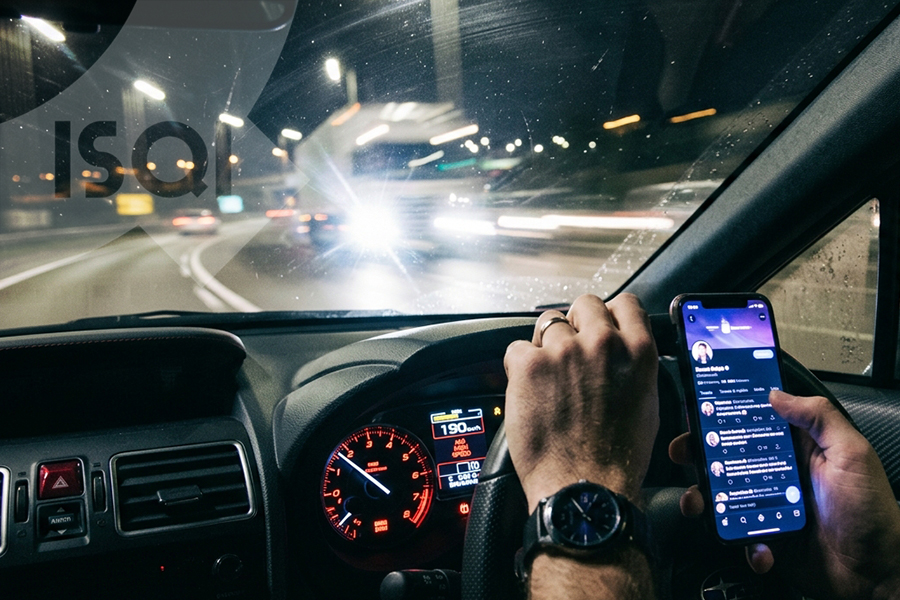
According to a new analysis by the Insurance Institute for Highway Safety (IIHS) using data collected from insurance-linked safe driving apps, drivers who exceed the speed limit are also more likely to use their cell phones while driving. This pattern suggests that the combination of speeding and phone-related distraction can significantly increase crash risk.
David Harkey, President of IIHS, commenting on the findings, said:
“Previously, it was assumed that cell phone use occurred more often at lower speeds. However, real-world data shows that in free-flowing traffic, this behavior also increases at higher speeds.”
The analysis found that, after excluding periods when vehicles were stopped or driving in heavy traffic or local roads, phone use increased as speeding increased. On limited-access roads such as freeways, every 5 mph increase above the speed limit was associated with a 12% increase in the proportion of time drivers spent using their phones. These roads are accessible only via entry and exit ramps.
On other road types, such as urban highways and intercity roads, the increase averaged about 3% per 5 mph over the speed limit. These roads typically include intersections, traffic signals, and more frequent traffic controls.
Stronger Pattern on High-Speed Roads
The relationship was even stronger on roads with higher posted speed limits. For example, on limited-access roads with a 70 mph speed limit, the increase in phone use per 5 mph over the limit was about 9% higher than on similar roads with a 55 mph speed limit.
A similar pattern was observed across other road types as well. On roads with speed limits of 45–50 mph, phone use increased by about 3% per 5 mph over the limit compared with lower-speed roads, while on 55 mph roads this figure rose to about 7%.
Ian Reagan, IIHS senior research scientist and lead author of the study, said:
“The most notable finding is that the association between phone use and speeding is stronger on roads with higher speed limits.”
Possible Explanations for Simultaneous Risky Behavior
Researchers suggest several possible explanations for this pattern. One possibility is that risk-prone drivers are more likely to both speed and use their phones. Another is the role of situational stress, such as peak-hour commuting or school drop-off routines, which may encourage both behaviors simultaneously.
It is also possible that environmental conditions on higher-speed roads—such as lighter traffic, fewer pedestrians, and longer distances between intersections—reduce perceived risk and increase phone use.
Previous research has also shown that drivers are more likely to engage in distracted behaviors in simpler traffic environments or at lower speeds, but those studies did not fully capture the combined relationship between speeding and phone use.
Large-Scale Data from Safe Driving Apps
With the expansion of insurance-based safe driving apps, more detailed data on driving behavior has become available. These apps use GPS and smartphone sensors to record speed, location, acceleration, harsh braking, trip timing, and phone usage.
In this study, Ian Reagan and Sam Monfort, IIHS senior statistician, analyzed nearly 600,000 trips taken between July and October 2024 across the United States. Alaska, California, Hawaii, and New York were excluded from the analysis.
The dataset was provided by Cambridge Mobile Telematics (CMT) and included drivers using insurance-linked driving apps. Only trips lasting at least 18 minutes and including at least 2 minutes of interstate highway driving were included. To focus on free-flow traffic conditions, segments where vehicles traveled more than 5 mph below the speed limit were excluded.
Phone use was detected when the device’s gyroscope identified significant movement while the screen was active. Speeding was determined by matching GPS data with posted speed limits.
Implications for Traffic Enforcement and Road Safety
These findings suggest that speeding and phone use often occur together, especially on high-speed roads. This insight could help improve targeted enforcement strategies.
According to researchers, addressing both behaviors simultaneously—speeding and distracted driving—may be more effective in reducing crashes than treating each behavior separately, particularly on highways and limited-access roads.
While enforcement against phone use can be challenging in some situations, technologies such as automated cameras and monitoring systems may play an important role in detecting and addressing these behaviors.
Researchers also note that insurance-based telematics programs may help reduce both speeding and phone use by offering financial incentives to drivers who avoid risky behavior, at least among voluntarily enrolled users.
Author: Zahra Shirband – International Relations Expert ISQI
Source: IIHS