

Introduction
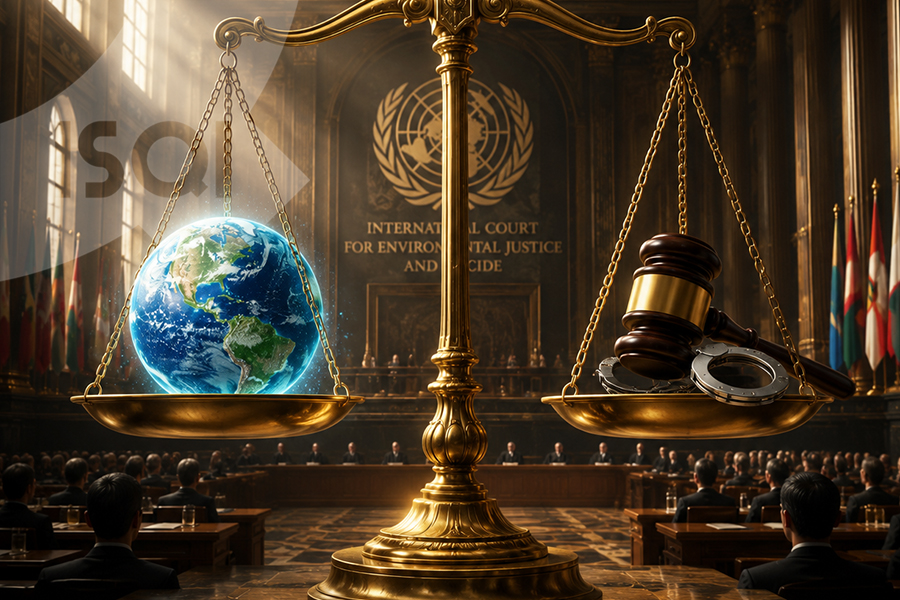
Within the system of international criminal law, only the gravest and most dangerous conduct is defined as international crimes. These crimes are generally considered threats to peace, security, and the conscience of humanity. At present, the International Criminal Court (ICC) prosecutes four core crimes. The fundamental question is whether large-scale environmental destruction should be placed at the same level. The concept of ecocide has emerged precisely in response to this question.
The Relationship Between Ecocide and International Crimes
Conceptually, ecocide bears significant similarities to other international crimes. Just as genocide involves the destruction of a human group based on identity, ecocide concerns the destruction of a biological system that may sustain human communities. In many cases, widespread environmental destruction directly leads to forced displacement, famine, disease, and even loss of life.
The Rome Statute, in Article 8 concerning war crimes, refers to “widespread, long-term and severe damage to the natural environment.” This indicates that international law recognizes the importance of environmental protection. However, this protection is limited to situations of armed conflict and does not extend to peacetime. As a result, there is a significant legal gap regarding large-scale environmental destruction committed during times of peace.
Efforts to Amend the Rome Statute
Since around 2015, international campaigns to recognize ecocide as the fifth international crime have intensified. In 2021, an Independent Expert Panel proposed a formal legal definition that could potentially be adopted as an amendment to the Rome Statute.
To amend the Rome Statute, a member state must formally propose the amendment, and it must then receive approval by a two-thirds majority of States Parties. This is a complex and political process, as some countries are concerned about the economic and industrial implications of criminalizing ecocide.
Has Ecocide Become an International Crime by 2026?
As of 2026, ecocide has not been formally added to the list of crimes under the jurisdiction of the International Criminal Court. Therefore, it is not currently recognized as an independent international crime.
However, several important developments have taken place:
– Several European and Latin American countries have incorporated concepts similar to ecocide into their domestic legislation.
– In 2024, the European Union adopted a new Environmental Crime Directive providing for stricter penalties for serious environmental offenses.
– Political support from climate-vulnerable states has increased significantly.
Thus, although ecocide is not yet a formal international crime, its legal recognition is progressing.
The Difference Between Ecocide and Ordinary Environmental Offenses
Ordinary environmental violations typically involve breaches of administrative regulations, such as exceeding pollution limits or illegal waste disposal. These offenses are generally addressed at the national level, and their impacts are often limited and reversible.
In contrast, ecocide refers to destruction whose consequences are felt at a regional or global scale and whose damage is difficult—or even impossible—to reverse. The key distinctions therefore lie in the scale, severity, and human and ecological consequences of the harm.
The Current Status in 2026
In 2026, ecocide stands at an intermediate stage between theoretical discourse and formal legal realization. While it has not yet been codified as an international crime, it has gained considerable moral and political legitimacy. Many legal scholars argue that as climate crises intensify, pressure for its criminalization will continue to grow.
Conclusion:
Ecocide is an emerging concept in international law that seeks to elevate large-scale environmental destruction to the level of international crimes. Although it has not yet been incorporated into the Rome Statute, current legal and political trends suggest that the concept may play a significant role in the future evolution of international law.
Author: Zahra Shirband – International Relations Expert
Sources:
- Rome Statute of the International Criminal Court (1998).
- Independent Expert Panel (2021). Definition of Ecocide.
- European Union Environmental Crime Directive (2024).
- Higgins, P. (2010). Eradicating Ecocide.
- Schabas, W. (2017). An Introduction to the ICC.