

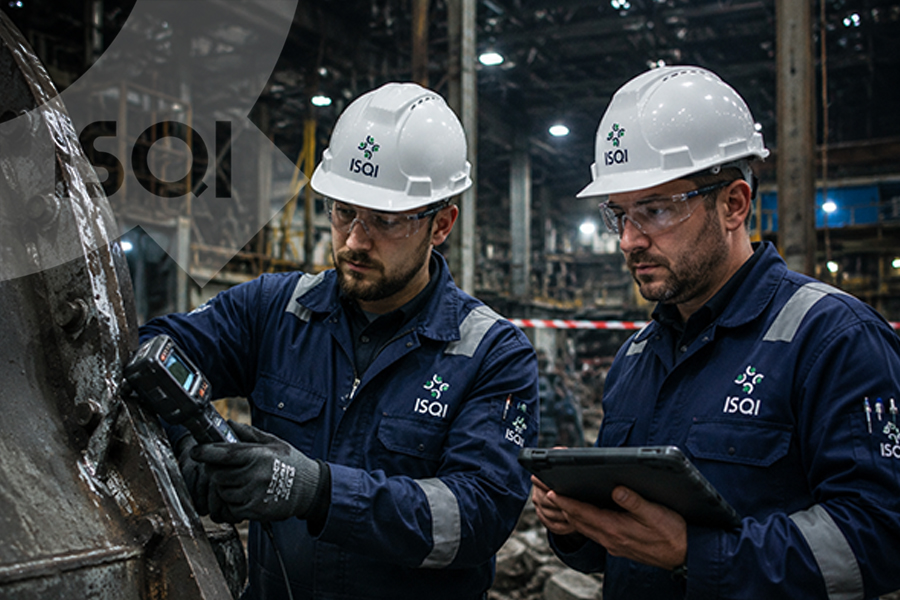
Industrial disasters—ranging from earthquakes and floods to widespread fires—do not merely target physical assets; they challenge “business continuity.” In such circumstances, the pressure for a rapid return to the production line can lead to hasty decisions and irreversible secondary accidents. Smart recovery management is not a rushed process, but a precise engineering operation anchored in two pillars: “structural integrity” and “machinery health.”
- Infrastructure Assessment; Beyond First Impressions
The first step after a crisis is structural assessment. Industrial structures, due to dynamic loads and equipment weight, are susceptible to hidden damage.
Geometric Stability Assessment: In many cases, columns and foundations suffer from asymmetrical settlement not visible to the naked eye. Using precision surveying equipment (Total Stations) to check for column deviation from the primary axis is the primary prerequisite for safety.
Detection of Hidden Cracks: In steel structures, welded connections at beam-to-column joints are strategic points. Assessing these areas with Non-Destructive Testing (NDT) methods, such as “dye penetrant inspection,” is essential to ensure the absence of micro-cracks that could lead to collapse under future loads.
- Machinery; Reviving the Heartbeat of Production
Industrial machinery is often the victim of severe tremors and vibrations post-crisis. Equipment alignment, which may have been precisely calibrated during installation, is likely now compromised.
From Alignment to Calibration: The slightest misalignment of shafts can lead to premature bearing fatigue and costly failures once started. Using “Laser Alignment” to return to factory tolerances is the most critical step in reviving rotating equipment.
Electronic Health: Voltage fluctuations caused by damage to industrial power grids can affect PLC memory and control systems. Before startup, software review and instrumentation calibration are necessary to prevent operational errors that could jeopardize the entire production line.
- “Phased Recovery” Strategy
The biggest mistake in reconstruction is starting all production lines simultaneously. A successful strategy involves “Pilot Startup.” In this method, only the portion of the line with the lowest mechanical stress is activated, allowing secondary systems (such as cooling or power supply) to be monitored under precise surveillance. During this phase, “Vibration Analysis” is the best tool for identifying anomalies before major failure occurs.
Final Word; Standards as a Guiding Light
Reconstruction without reliance on global standards is like operating in the dark. For technical documentation and obtaining startup permits, engineers must refer to the following:
Structures: ASCE 41 (Seismic Evaluation) and FEMA P-352 (Global reference for steel structure repair).
Machinery: API 686 (Specialized guide for equipment installation and alignment) and ISO 10816 (Vibration condition monitoring).
Management: ISO 22301 (Business Continuity), which provides a framework for fast and safe recovery.
Ultimately, returning to production after a crisis is a test of an organization’s technical management capabilities. By combining engineering knowledge, modern condition-monitoring equipment, and adherence to international standards, the great threat of a crisis can be transformed into an opportunity for modernization and organizational safety enhancement.
Author: Zahra Shirband – International Relations Expert ISQI
Sources:
- ASME PCC-2: Repair of Pressure Equipment and Piping (Reference standard for temporary and permanent repairs of pressure equipment and pipelines post-damage).
- NFPA 25: Inspection, Testing, and Maintenance of Water-Based Fire Protection Systems (Critical standard for ensuring the health of fire suppression systems after a crisis).
- IEEE 43: Recommended Practice for Testing Insulation Resistance of Electric Machinery (Specialized reference for testing insulation health of electric motors and generators after moisture or dust ingress).
- ISO 31000: Risk Management — Guidelines (International standard for assessing residual risks and determining risk acceptance protocols during the restart phase).
- ASTM E213: Standard Practice for Ultrasonic Testing of Metal Pipe and Tubing (Global standard for identifying micro-cracks and hidden structural defects in critical components using ultrasonic methods)