
Pipelines in the oil and gas industry are among the most important infrastructures for transporting crude oil, petroleum products, and natural gas. These pipelines often operate under harsh conditions such as high pressure, varying temperatures, exposure to corrosive chemical compounds, and humid or underground environments. One of the most significant factors that can damage these pipelines is corrosion. Corrosion can lead to wall thickness reduction, leakage, sudden failure, and even serious environmental and economic consequences. Therefore, technical inspection and early detection of corrosion are essential parts of maintenance programs and pipeline integrity management systems in the oil and gas industry.
Corrosion in pipelines can occur due to several factors. Some of the most important causes include the presence of water, acidic gases such as carbon dioxide (CO₂) and hydrogen sulfide (H₂S), temperature and pressure fluctuations, microbial activity, and damage to protective coatings. In buried pipelines, soil chemistry, moisture, and stray electrical currents can also cause external corrosion. In contrast, internal corrosion is usually caused by chemical components present in the transported fluid.
From an engineering perspective, corrosion in pipelines can be categorized into several major types. Uniform corrosion is one of the most common types, in which the wall thickness of the pipe decreases relatively evenly over the internal or external surface. In contrast, pitting corrosion appears as small but deep cavities on the metal surface and is considered very dangerous because it can cause rapid perforation of the pipeline without significant overall wall thinning. Another type is galvanic corrosion, which occurs when two dissimilar metals are in electrical contact in the presence of an electrolyte. In pipelines transporting sour oil and gas, hydrogen sulfide corrosion can cause problems such as sulfide stress cracking. Additionally, in some situations, bacterial activity—particularly sulfate-reducing bacteria—can lead to microbiologically influenced corrosion (MIC).
To prevent severe damage caused by corrosion, different technical inspection and monitoring techniques are used. These methods are generally divided into two categories: external inspection and internal inspection of pipelines.
One of the simplest inspection methods is visual inspection. In this method, the external surface of the pipeline and associated equipment are examined directly to identify signs such as rust, coating damage, cracks, or leakage. Although this method is simple and inexpensive, it can only detect visible surface defects and cannot accurately determine wall thickness loss.
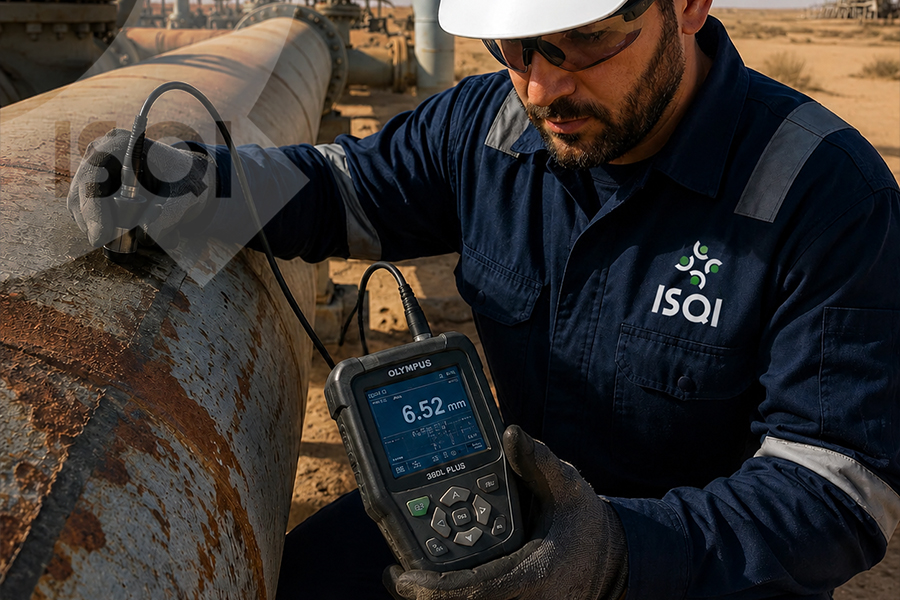
A widely used method for corrosion detection is Ultrasonic Testing (UT). This technique uses high-frequency sound waves to measure the thickness of the pipeline wall. The ultrasonic device sends sound waves into the metal and measures the time it takes for the reflected waves to return from the internal surface. Based on this time, the remaining wall thickness of the pipe can be calculated. Ultrasonic testing provides high accuracy and is widely applied in periodic inspections of pipelines to detect corrosion-related wall thinning.
Another important technique is Magnetic Flux Leakage (MFL). This method is commonly used in internal pipeline inspections with devices known as smart pigs. In MFL inspection, the pipeline wall is magnetized to near saturation. If there is metal loss caused by corrosion or other defects, part of the magnetic field leaks out of the pipe wall. Sensors in the technical inspection tool detect these leakage fields and record data that indicate the location and severity of corrosion damage.
Radiographic Testing (RT) is also used for detecting internal defects. This method uses X-rays or gamma rays to produce images of the internal structure of the pipeline. Radiography can reveal voids, areas of metal loss, and certain types of defects. However, its use in long transmission pipelines is somewhat limited due to operational constraints.
In addition to these inspection techniques, corrosion monitoring systems are also installed in pipelines. One common method involves the use of corrosion coupons. In this technique, a small metal sample made from the same material as the pipeline is placed in the flowing fluid. After a certain period, the sample is removed and its weight loss is measured to determine the corrosion rate. Another method uses electrical resistance (ER) probes, which measure changes in electrical resistance caused by the reduction of the metal’s cross-sectional area due to corrosion.
Once corrosion damage has been detected, engineers perform an evaluation to determine the severity of the defect and its impact on pipeline integrity. One widely used standard for this purpose is ASME B31G, which provides procedures for assessing the remaining strength of corroded pipelines. By applying such standards, engineers can determine whether the pipeline can safely continue operating at its current pressure or whether repair, reinforcement, or replacement is required.
In recent years, advanced technologies have also been developed for pipeline inspection and corrosion detection. These include fiber optic sensing systems, online corrosion monitoring technologies, robotic inspection tools, drones for external inspections, and artificial intelligence for analyzing inspection data. These technologies enable faster and more accurate detection of defects, improving operational safety and reducing maintenance costs.
In conclusion, corrosion represents one of the most critical technical challenges in the operation of oil and gas pipelines. Implementing comprehensive technical inspection programs, applying advanced non-destructive testing methods, and utilizing modern corrosion monitoring technologies play a vital role in extending pipeline service life, enhancing operational safety, and protecting the environment.
Author: Zahra Shirband – International Relations Expert ISQI
Sources:
- API Recommended Practice 570, Piping Inspection Code: In-service Inspection, Rating, Repair, and Alteration of Piping Systems, American Petroleum Institute.
- ASME B31G, Manual for Determining the Remaining Strength of Corroded Pipelines, American Society of Mechanical Engineers.
- Peabody, A. W. (2001). Control of Pipeline Corrosion. NACE International.
- Revie, R. W., & Uhlig, H. H. (2008). Corrosion and Corrosion Control. John Wiley & Sons.
- Baboian, R. (2005). Corrosion Tests and Standards: Application and Interpretation. ASTM International.
- NACE International (2013). Corrosion Basics: An Introduction. NACE International.