

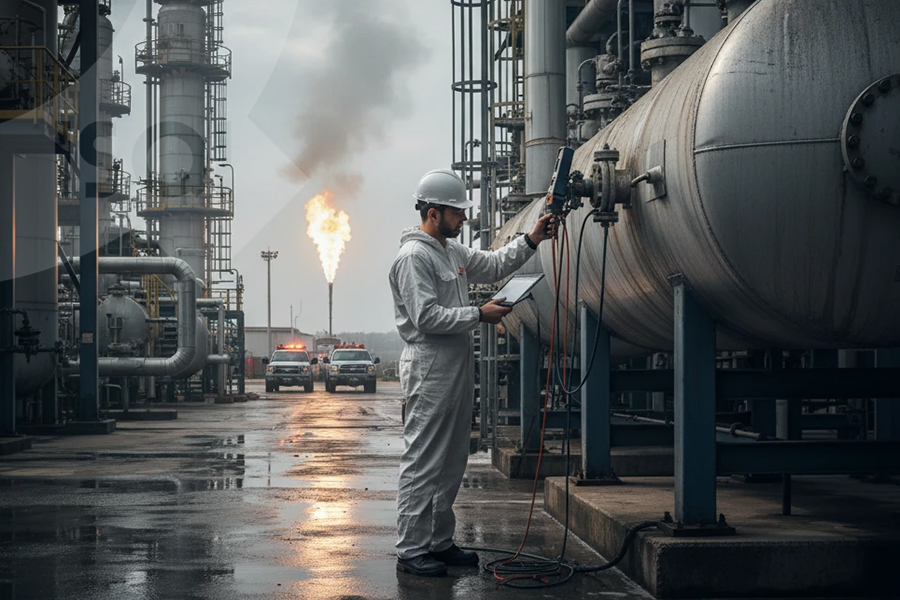
In process industries such as oil, gas, petrochemicals, and power plants, equipment inspection plays a vital role in maintaining safety, reliability, and production continuity. Under normal conditions, inspection programs are carried out based on periodic schedules and established standards; however, during crises such as industrial accidents, natural disasters, wars, disruptions in supply chains, or severe limitations in human resources, it may not be possible to fully implement the inspection program. In such circumstances, using the risk-Based Inspection (RBI) approach can be an effective tool for prioritizing inspection activities and focusing on critical equipment.
The RBI method is based on the principle that not all equipment is equal in terms of the probability of failure and its consequences. Therefore, limited inspection resources should be allocated to equipment that poses the highest risk to safety, the environment, or production. Risk is commonly defined as the product of the Probability of Failure (PoF) and the Consequence of Failure (CoF). In crisis situations, where time, manpower, or inspection tools are limited, this approach helps organizations maintain the highest possible level of safety with minimal resources.
In the first stage of implementing RBI in emergency conditions, process equipment and systems must be identified and categorized. This is typically done using design data, maintenance history, corrosion records, and operating conditions. Then, the probability of failure for each item is assessed based on damage mechanisms such as corrosion, fatigue, cracking, or erosion. At the same time, the consequences of failure are analyzed in terms of personnel safety, economic loss, production downtime, and environmental impact.
In crisis conditions, the main focus is on equipment that has both a high probability of failure and severe consequences. For example, pressure vessels containing flammable materials, pipelines carrying hazardous fluids, or key process equipment are usually placed in the highest inspection priority. In contrast, equipment with a low probability of failure or limited consequences may be deferred in the inspection schedule without creating significant risk.
One of the key advantages of RBI in emergency situations is the optimization of limited resources. During crises, access to advanced inspection technologies, specialized experts, or even spare parts may be restricted. By using risk analysis, technical teams can decide which equipment must be inspected immediately and which ones can be postponed until conditions return to normal. This data‑driven decision‑making ensures that major risks are controlled and the likelihood of catastrophic events is reduced.
Moreover, RBI helps organizations achieve fast and well‑documented decision‑making. In times of crisis, management decisions are often made under time pressure. If inspection prioritization is carried out within a scientific framework such as RBI, decisions become more defensible and coordination among operations, safety, and management departments becomes easier.
Despite its many benefits, effective implementation of Risk-Based Inspection requires access to accurate data and technical expertise. In some cases, a lack of information about the actual condition of equipment can make risk analysis challenging. Therefore, it is recommended that organizations develop asset management systems, corrosion databases, and condition monitoring programs before crises occur, so that RBI analyses can be performed more quickly and accurately during emergency situations.
Overall, the Risk‑Based Inspection method is an effective tool for managing equipment safety during crises. By focusing on high‑risk equipment, this approach enables the optimal use of limited resources and helps organizations maintain an acceptable level of safety and reliability even under emergency conditions. For this reason, many major industries today use Risk-Based Inspection (RBI) as a part of their overall risk management and maintenance strategy.
Author: Zahra Shirband – International Relations Expert ISQI
Sources:
- API Recommended Practice 580, Risk‑Based Inspection, American Petroleum Institute, 2016.
- API Recommended Practice 581, Risk‑Based Inspection Methodology, American Petroleum Institute, 2016.
- Rausand, M. (2014). Risk Assessment: Theory, Methods, and Applications. Wiley.
- CCPS (Center for Chemical Process Safety). (2008). Guidelines for Risk Based Process Safety. AIChE.
- Khan, F., & Haddara, M. (2003). “Risk-Based Maintenance of Process Plant Equipment.” Journal of Loss Prevention in the Process Industries.