
With the expansion of drilling activities and the increasing complexity of equipment used in the oil and gas industry, ensuring the health and mechanical integrity of equipment has become one of the most critical operational concerns. Drilling rigs and their vital components—especially systems such as Blowout Preventers (BOP), Top Drive, Drawworks, and Crown Block—operate under extremely harsh working conditions. Even minor defects in these systems can lead to operational shutdowns, significant financial losses, or even safety incidents. Therefore, continuous inspection and condition monitoring of this equipment are of great importance.
In the past, drilling equipment inspection was mainly based on traditional methods such as visual inspection, manual measurement tools, and basic non-destructive testing techniques. Although these methods are still used in many projects, limitations such as heavy reliance on inspector experience, limited measurement accuracy, and non-systematic data recording have made them insufficient for today’s complex industrial requirements. In recent years, modern approaches based on digitalization and advanced measurement and testing technologies have opened a new horizon in drilling equipment inspection.
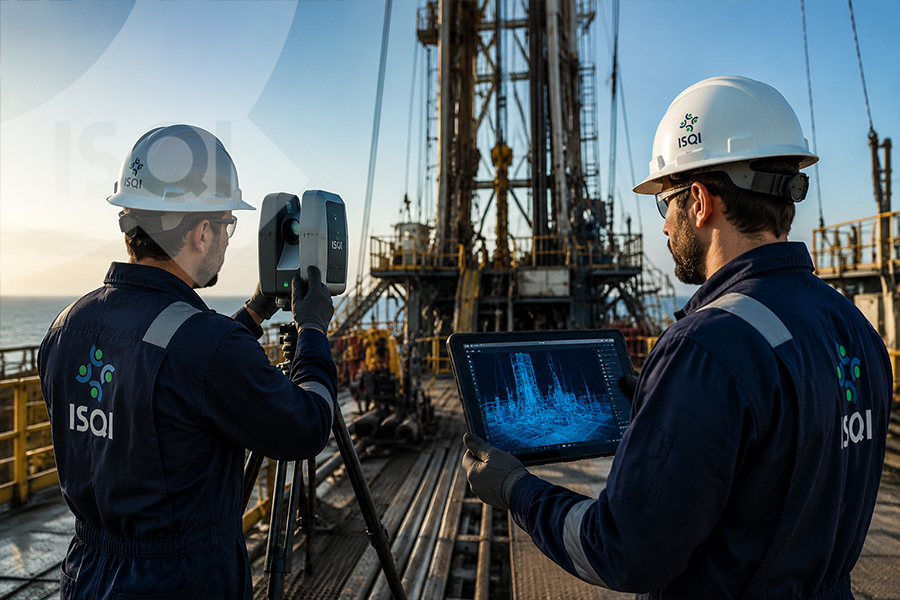
One of the most important of these approaches is the simultaneous use of 3D laser scanning, precise geometric measurement, and advanced non-destructive testing methods. In this approach, critical rig equipment is first selected based on risk analysis and operational importance. Components such as the BOP, Drawworks, Top Drive, sheaves, and Crown Block are typically prioritized for inspection. Then, using 3D laser scanners, these components are scanned in situ without the need for full disassembly.
3D scanners are capable of capturing millions of surface points in a short time and generating a highly accurate digital model known as a “point cloud.” This 3D model provides a precise representation of the actual condition of the equipment and enables the detection of deformations, corrosion, and geometric deviations. Since this process can be performed on-site and even on the rig floor, operational downtime is minimized and the need for full disassembly is reduced.
After generating the initial model, portable metrology tools are used to measure critical geometric dimensions and features. These tools are capable of extremely high-precision measurements at the micron level and determine how well components conform to their original design specifications. Such measurements are particularly important for parts exposed to wear or high mechanical loads.
In addition to geometric inspection, advanced non-destructive testing (NDT) methods are used to evaluate the internal integrity of components. One commonly used technique is Phased Array Ultrasonic Testing, which enables the detection of cracks, voids, and other internal discontinuities. This method can identify defects that are not detectable through visual inspection or conventional techniques.
One of the key advantages of this approach is the integration of 3D scanning data with NDT results into a unified digital model. In this model, the exact location of detected defects is mapped onto the actual geometry of the equipment, allowing engineers to gain a comprehensive understanding of its real condition. Such a report is not only useful for current condition assessment but also serves as a baseline for comparison in future inspections.
The data obtained from these inspections can also be integrated into Computerized Maintenance Management Systems (CMMS). This allows equipment condition data to be stored in a structured format and enables long-term trend analysis. This capability supports the implementation of predictive maintenance and condition-based maintenance strategies.
Condition-based maintenance means that decisions regarding repair or replacement of components are made based on their actual condition rather than predetermined schedules. This approach reduces unnecessary maintenance, minimizes equipment downtime, and optimizes the use of maintenance resources.
Overall, the use of digital technologies in drilling rig inspection can significantly enhance the accuracy and efficiency of inspection processes. The creation of precise 3D equipment models, early defect detection, systematic data recording, and long-term condition analysis are among the key benefits of this approach.
Given the ongoing digital transformation in the oil and gas industry, it is expected that advanced inspection methods such as 3D scanning and advanced non-destructive testing will gradually become standard practices in drilling equipment health management. This transformation will not only improve operational safety but also play an important role in reducing costs and increasing efficiency in drilling projects.
Author: Zahra Shirband – International Relations Expert ISQI
Source: Innovative Digital Inspection Methods (https://doi.org/10.4043/29387-MS)