

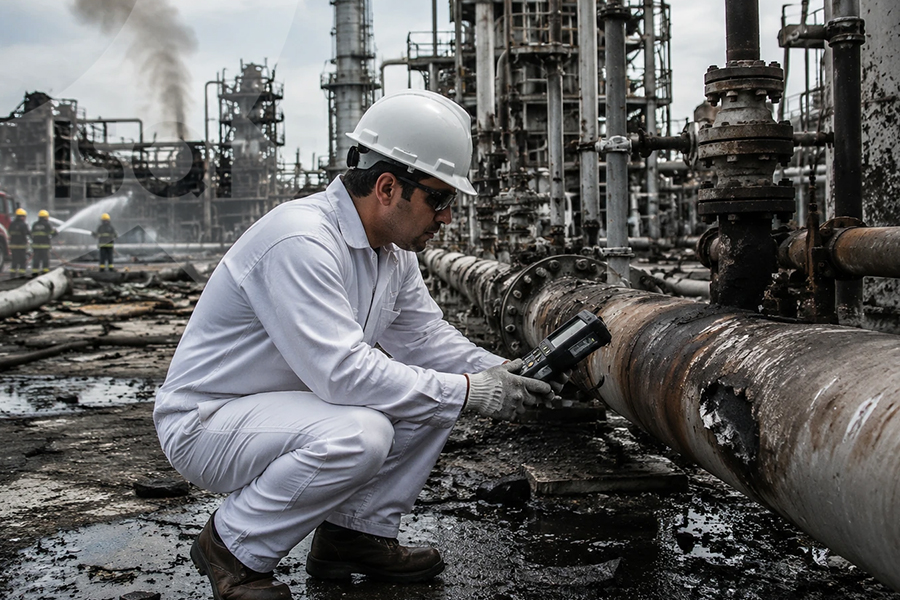
Major disasters such as earthquakes, industrial fires, and explosions in refineries or manufacturing plants are among the crises that can cause extensive human, economic, and environmental losses. In such events, conducting accurate and systematic Oil and gas inspection after the incident plays a crucial role in crisis management, reducing secondary risks, and restoring environmental safety.
Post‑disaster inspection refers to a set of technical and managerial activities aimed at assessing damages, identifying residual hazards, and planning for reconstruction and safety restoration.
- Post‑Earthquake Inspection
After an earthquake, the first stage of crisis management is a rapid assessment of the condition of structures and infrastructure. Inspection teams typically include structural engineers, safety specialists, emergency personnel, and crisis management experts. Buildings are examined for structural cracks, partial collapses, instability, and damage to load‑bearing elements.
Such inspections are performed at two levels: rapid visual assessment and detailed technical evaluation. During the initial Oil and gas inspection, buildings are marked with safety tags (green, yellow, or red) indicating whether they are safe for occupancy. In the detailed stage, structural analysis, foundation evaluation, and assessments of water, electricity, and gas networks are carried out to identify the risk of secondary hazards such as gas leaks or fires.
Particular attention is paid to critical infrastructure such as bridges, power transmission lines, hospitals, and emergency service centers. The collected data help decision‑makers determine priorities for recovery and relief operations.
- Post‑Fire Inspection in Industrial Facilities
Industrial fires can lead to severe equipment damage, the release of hazardous substances, and secondary hazards. After extinguishing the fire, inspection teams must ensure the site is safe. Initially, inspectors confirm that the fire has been fully suppressed and that no chance of re‑ignition exists.
Inspection involves the examination of:
– Damage to metallic or concrete structures
– Condition of production lines and industrial equipment
– Presence of chemical or toxic gas leaks
– Performance of fire detection and suppression systems
An essential element of post‑fire inspection is fire cause analysis. Experts investigate physical evidence, the fire’s point of origin, and the behavior of safety systems to identify root causes. These findings are critical for preventing recurrence of similar incidents.
- Post‑Explosion Inspection in Refineries or Factories
Explosions in refineries and chemical plants are often triggered by flammable material leaks, pressure build‑up in storage tanks, or equipment failures. These events can cause catastrophic damage to process units, pipelines, and surrounding buildings.
Following an explosion, inspection teams must first ensure environmental safety—checking for combustible gases, hazardous material spills, and risks of secondary explosions. Once the area is secured, technical Oil and gas inspection begins, including:
– Examination of storage tanks and pipelines
– Assessment of damage to process equipment
– Evaluation of control and safety systems
– Analysis of structural impacts on surrounding facilities
Technologies such as thermal cameras, gas sensors, and drones are often employed to investigate high‑risk zones. Reviewing operational data and incident logs prior to the explosion also assists investigators in determining the root cause.
- Importance of Documentation and Reporting
A vital stage in crisis inspection is accurate documentation and reporting. Reports should include a detailed description of the incident, the extent of damage, remedial measures, and recommendations for improving safety systems. Proper documentation enables organizations to learn from past incidents and strengthen their safety and crisis‑management frameworks.
Conclusion
Post‑disaster inspection after events such as earthquakes, industrial fires, and refinery explosions is essential for reducing risk, protecting human life, and restoring normal operations. Implementing scientific and precise inspection protocols, deploying multidisciplinary teams, and employing modern technologies help to identify hazards quickly and prevent secondary disasters. Moreover, analyzing Oil and gas inspection results provides a foundation for improving safety standards and crisis‑management strategies in industries and urban environments.
Author: Zahra Shirband – International Relations Expert ISQI
Sources:
- Alexander, D. (2015). Principles of Emergency Planning and Management. Oxford University Press.
- FEMA (Federal Emergency Management Agency). (2018). Post‑Disaster Building Safety Evaluation Guidance.
- NFPA (National Fire Protection Association). (2022). NFPA Fire Protection Handbook.
- CCPS (Center for Chemical Process Safety). (2019). Guidelines for Investigating Chemical Process Incidents.
- Coppola, D. (2020). Introduction to International Disaster Management. Elsevier.
- National Disaster Management Organization of Iran (2021). Post‑Disaster Damage Assessment and Response Guidelines.