
Introduction
Over the past few decades, the development of automotive safety systems has shifted from focusing solely on reducing injury severity after a crash toward preventing accidents before they occur. This transformation has made Active Safety Systems an essential component of modern vehicle design. Among these systems, Electronic Stability Control (ESC) is considered one of the most effective active safety technologies, significantly reducing the likelihood of many accidents by preventing skidding, lane departure, and loss of vehicle control.
Studies conducted by the National Highway Traffic Safety Administration (NHTSA) have shown that ESC can substantially reduce crashes resulting from roadway departure, vehicle rollover, and loss of control in critical driving situations. Research by the Insurance Institute for Highway Safety (IIHS) has likewise identified ESC as one of the most effective active safety technologies ever developed for the automotive industry. Consequently, ESC has become mandatory for passenger cars and light commercial vehicles in many countries, and its performance must comply with standards such as FMVSS No. 126 in the United States and UNECE Regulation No. 140 in countries that are members of the United Nations Economic Commission for Europe.
Unlike passive safety systems such as seat belts and airbags, which protect occupants after a collision has occurred, ESC intervenes before an accident takes place. Through intelligent intervention in the braking system and engine torque management, it attempts to keep the vehicle on the path intended by the driver. For this reason, ESC is regarded as one of the most important preventive safety technologies in modern vehicles.
Operating Principle of the Electronic Stability Control System
The operation of an ESC system is based on comparing the vehicle’s reference behavior with its actual behavior. When the driver turns the steering wheel, the system’s Electronic Control Unit (ECU) calculates the vehicle’s desired yaw rate and other expected motion parameters using the steering angle, vehicle speed, and a reference vehicle dynamics model. These values represent how the vehicle should behave under ideal conditions.
At the same time, the vehicle’s actual condition is measured or estimated using a variety of sensors. By comparing the actual behavior with the reference behavior, the ECU determines the vehicle’s deviation from the intended path. If this deviation exceeds a predefined threshold, the system recognizes that the vehicle is approaching a loss of stability and automatically initiates corrective actions without requiring direct driver intervention.
The principal sensors used in an ESC system include:
- Steering Angle Sensor
- Wheel Speed Sensors for all four wheels
- Yaw Rate Sensor
- Lateral Acceleration Sensor
- Brake Hydraulic Pressure Sensor
- Longitudinal Acceleration Sensor (in many vehicles)
- Body Roll Angle Sensor (in some vehicles, particularly SUVs)
- Information received from the Engine Control Unit (ECU), Electric Power Steering (EPS), Anti-lock Braking System (ABS), and the CAN communication network
In modern vehicles, the ECU also uses vehicle dynamics models to estimate variables such as the sideslip angle, a parameter that is generally impractical to measure directly in mass-produced vehicles.
ESC Intervention Under Critical Driving Conditions
When the system detects that the vehicle has deviated from its intended path, it restores stability using two primary strategies:
- Selective braking of one or more wheels
- Reduction of engine output torque
Selective braking generates a corrective yaw moment that helps steer the vehicle back toward its desired trajectory.
For example, if the vehicle experiences oversteer, causing the rear of the vehicle to slide outward, the system typically applies braking to one wheel (most commonly the outside front wheel) to generate a corrective yaw moment, thereby reducing the vehicle’s yaw rate and restoring stability. Conversely, if the vehicle experiences understeer and tends to drift toward the outside of the corner, the system may apply braking to one of the rear wheels to generate the yaw moment required to increase the vehicle’s turning response. The precise control strategy varies among manufacturers depending on the vehicle architecture and the control algorithm, and the exact wheel selected for braking may differ.
In many situations, ESC also communicates with the Engine Control Unit (ECU) to reduce engine torque, thereby preventing further instability.
System Response Speed
One of the most important characteristics of ESC is its exceptionally fast response time. The control unit receives data from multiple sensors at sampling rates ranging from several tens to several hundreds of Hertz and executes its control algorithms within intervals of only a few milliseconds.
As a result, the system’s reaction time is typically much shorter than that of a human driver. In many critical situations, ESC intervenes and helps maintain vehicle stability before the driver can perform an effective corrective action.
It should be emphasized that ESC is not a substitute for driver skill or the laws of physics. Rather, it is a driver assistance system that reduces the likelihood of losing vehicle control within the limits of the vehicle’s dynamic capabilities. Factors such as excessive vehicle speed, extremely low road friction, or maneuvers beyond the vehicle’s physical limits can reduce the effectiveness of the system.
Importance of ESC Performance Evaluation
Simply equipping a vehicle with an ESC system does not guarantee satisfactory performance. The system must operate reliably across a wide range of driving conditions, including different vehicle speeds, varying road friction coefficients, sudden maneuvers, and other critical situations.
For this reason, vehicle manufacturers and automotive testing organizations evaluate ESC performance according to internationally recognized standards before a vehicle is released to the market.
In the United States, ESC performance requirements are defined in FMVSS No. 126, while UNECE Regulation No. 140 serves as the legal reference in UNECE member countries.
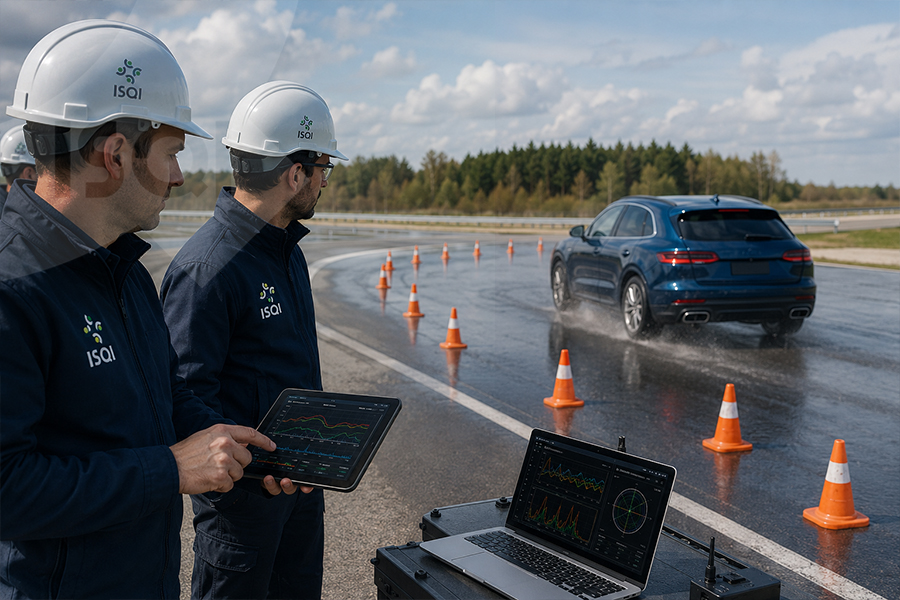
In addition to the mandatory procedures specified by these regulations, well-established dynamic maneuvers such as ISO 3888 (Double Lane Change), Fishhook, and J-Turn are widely used during vehicle development and validation to evaluate vehicle dynamics and assess ESC performance.
These tests enable engineers to evaluate the degree of ESC intervention, the vehicle’s ability to maintain its intended path, its resistance to skidding, and its rollover resistance under various driving conditions, playing a vital role in the development of safer vehicles.
Conclusion
Electronic Stability Control (ESC) is one of the most important active safety technologies in modern automobiles. By utilizing data from multiple sensors, vehicle dynamics models, and advanced control algorithms, the system helps prevent many forms of instability caused by understeer, oversteer, skidding, and, in certain situations, vehicle rollover. Its rapid response and intelligent intervention through braking and engine torque management play a significant role in improving vehicle safety and reducing the likelihood of accidents.
Nevertheless, understanding how ESC operates is only one part of evaluating this technology. To ensure that the system performs correctly, vehicles must successfully complete a series of standardized dynamic tests that accurately assess their ability to maintain stability under critical driving conditions.
Part Two of this series will examine the principal standardized ESC evaluation tests—including Sine with Dwell, Double Lane Change, Fishhook, and J-Turn—and discuss their role in verifying ESC performance.
Author: Zahra Shirband – International Relations Expert ISQI
References
- National Highway Traffic Safety Administration (NHTSA). Federal Motor Vehicle Safety Standard No. 126: Electronic Stability Control Systems. U.S. Department of Transportation.
- United Nations Economic Commission for Europe (UNECE). UN Regulation No. 140: Uniform Provisions Concerning the Approval of Passenger Cars with Regard to Electronic Stability Control (ESC) Systems.
- International Organization for Standardization (ISO). ISO 3888-1:2018, Passenger Cars — Test Track for a Severe Lane-Change Manoeuvre — Part 1: Double Lane Change.
- Rajamani, R. Vehicle Dynamics and Control, 2nd Edition. Springer, 2012.
- Gillespie, T. D. Fundamentals of Vehicle Dynamics. SAE International, 1992.
- Robert Bosch GmbH. Bosch Automotive Handbook, 10th Edition. Wiley, 2018.