


In recent years, automotive safety technologies have advanced significantly, leading to the development of numerous intelligent systems designed to reduce the risk of road accidents. Among these technologies, the Anti-lock Braking System (ABS), Traction Control System (TCS), and Electronic Stability Control (ESC) play the most important roles in maintaining vehicle control and enhancing driving safety.
Although these three systems are closely related and widely recognized by drivers, they are often mistakenly believed to perform the same function. In reality, each system is designed for specific driving conditions. While they work together and share certain components, their objectives and operating principles differ considerably. Understanding these differences helps drivers better appreciate their vehicle’s safety capabilities and recognize when each system becomes active.
ABS: Preventing Wheel Lock During Braking
The Anti-lock Braking System (ABS) is considered the first generation of electronic active safety systems in modern vehicles. Its primary purpose is to prevent the wheels from locking during hard or emergency braking.
In vehicles without ABS, sudden heavy braking may cause the wheels to lock completely. When this happens, the tires lose effective traction with the road surface, causing the vehicle to skid while becoming difficult or impossible to steer. This situation is particularly dangerous on wet, snowy, or icy roads.
ABS continuously monitors wheel speeds using dedicated wheel speed sensors. When the system detects that a wheel is about to lock, the Electronic Control Unit (ECU) momentarily reduces the hydraulic brake pressure on that wheel before rapidly reapplying it. This process is repeated several times per second, allowing the wheels to continue rotating while maintaining maximum braking performance.
As a result, the driver can continue steering the vehicle while braking heavily, significantly reducing the risk of collisions.
TCS: Preventing Wheel Spin During Acceleration
The Traction Control System (TCS) operates when the driven wheels lose traction during acceleration.
For example, when driving on wet pavement, snow, ice, or loose gravel, pressing the accelerator may cause the drive wheels to spin faster than the vehicle is actually moving. This condition, known as wheel spin, reduces acceleration efficiency and can make the vehicle difficult to control.
TCS uses the same wheel speed sensors employed by the ABS system to detect differences in wheel speed. Once excessive wheel spin is identified, the system intervenes by reducing engine torque, limiting fuel delivery, or applying brake force to the affected wheel.
By restoring traction, TCS improves vehicle stability and minimizes slipping during vehicle launch or acceleration.
ESC: Maintaining Vehicle Stability in Critical Situations
Electronic Stability Control (ESC) is the most advanced system among these three safety technologies. In addition to utilizing the functions of ABS and TCS, ESC incorporates additional sensors such as:
- Steering angle sensor
- Lateral acceleration sensor
- Yaw rate sensor
ESC continuously compares the driver’s intended direction, based on steering input, with the vehicle’s actual movement.
If the vehicle begins to deviate from its intended path due to excessive speed, slippery road conditions, or sudden evasive maneuvers, the system immediately detects the instability.
ESC then selectively applies braking force to one or more individual wheels and, when necessary, reduces engine power to help guide the vehicle back onto its intended trajectory.
For this reason, ESC is highly effective in preventing understeer, oversteer, road departure, and even vehicle rollovers.
Comparison of the Three Systems
The primary differences between ABS, TCS, and ESC can be understood by examining their operating conditions and objectives.
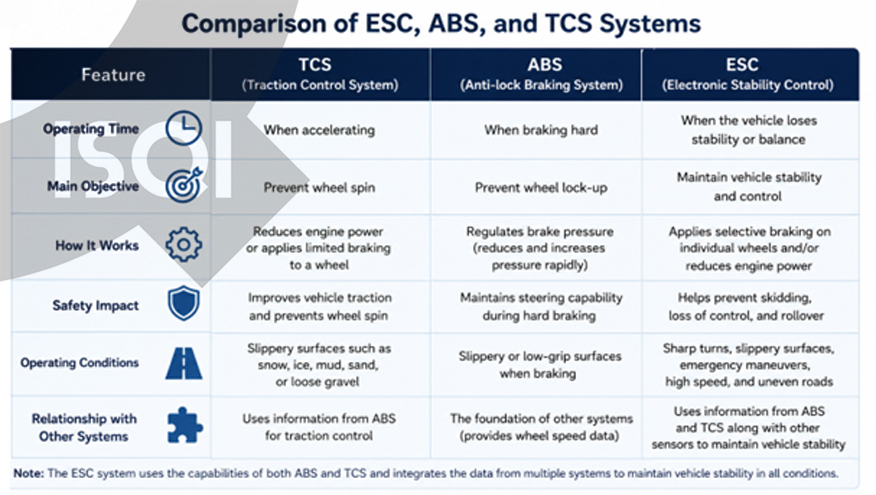
Why Is ESC More Important Than the Other Two Systems?
ABS and TCS each address specific aspects of vehicle dynamics, whereas ESC provides a much broader level of vehicle control. Rather than focusing solely on braking or acceleration, ESC simultaneously analyzes steering input, vehicle speed, lateral acceleration, yaw rate, and overall vehicle behavior.
For this reason, many automotive safety experts consider ESC to be the most important active safety technology introduced since the seat belt.
Research conducted by transportation safety organizations has shown that Electronic Stability Control significantly reduces the likelihood of rollover crashes and roadway departure accidents, making it one of the most effective vehicle safety innovations ever developed.
Conclusion
ABS, TCS, and ESC are all essential active safety technologies, but each serves a distinct purpose.
- ABS prevents wheel lock during braking.
- TCS prevents excessive wheel spin during acceleration.
- ESC combines the capabilities of both systems while continuously analyzing vehicle dynamics to maintain stability and directional control under critical driving conditions.
Understanding the differences between these technologies enables drivers to better appreciate how modern vehicles enhance safety. However, none of these systems can replace responsible driving. Instead, they function as intelligent driver-assistance technologies that reduce the likelihood of accidents and significantly improve occupant safety.
Author: Zahra Shirband – International Relations Expert ISQI
Sources:
- National Highway Traffic Safety Administration (NHTSA). Electronic Stability Control (ESC).
- Robert Bosch GmbH. Automotive Handbook, 10th Edition.
- Society of Automotive Engineers (SAE). Vehicle Dynamics and Control.
- Rajamani, R. Vehicle Dynamics and Control. Springer.
- Gillespie, T. D. Fundamentals of Vehicle Dynamics. SAE International.
- ISO 26262 – Road Vehicles – Functional Safety.
- European New Car Assessment Programme (Euro NCAP). Vehicle Safety Technologies.