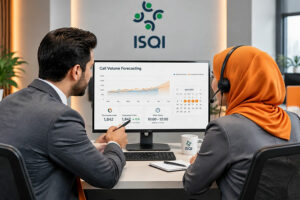

In a call center, the number of incoming calls is not constant throughout the day. There may be periods when the volume of calls is very high, followed by several hours during which demand decreases significantly. These fluctuations make workforce planning, shift scheduling, and maintaining service quality extremely challenging without accurate forecasting.
Call Forecasting is one of the most important tools in call center operations management. It helps organizations anticipate future demand and prepare the necessary resources before that demand occurs.
What Is Call Forecasting?
Call forecasting is the process of estimating the expected volume of future calls using historical data and factors that influence customer demand. Forecasting can be performed over different time horizons, ranging from daily and weekly forecasts to monthly and even annual forecasts.
However, the objective is not simply to answer the question, “How many calls will we receive tomorrow?” In a professional call center, it is necessary to determine how many calls are expected, when they are likely to arrive, and how much capacity will be required to handle them.
For example, a call center may receive 3,000 calls in a single day. However, if 1,200 of those calls arrive within a two-hour period, the workforce requirement during those two hours will be very different from the average workforce requirement for the entire day.
Therefore, forecasting should, whenever possible, consider smaller time intervals to provide a more accurate picture of demand.
Why Is Forecasting Important for Call Centers?
Accurate forecasting has a direct impact on operational decisions within a call center. One of its most important applications is workforce planning. If an organization knows the expected demand during each time period, it can determine the appropriate number of agents and schedule shifts based on actual demand patterns.
In the case of Under-Forecasting, the number of scheduled employees will be lower than the actual requirement. This can result in longer waiting times, increased queues, higher call abandonment rates, and lower service levels.
On the other hand, Over-Forecasting can also create problems. If an organization expects significantly more calls than actually occur, it may schedule more employees than necessary. In this situation, part of the available workforce capacity remains unused, increasing operational costs.
In practice, forecasting aims to balance two key objectives: providing an appropriate level of customer service and making efficient use of organizational resources.
Scientific research also indicates that forecasting call arrivals is one of the fundamental elements supporting staffing and scheduling decisions in call centers.
What Data Is Required for Forecasting?
One of the most important factors influencing forecasting performance is the quality of the input data. Historical call information can reveal patterns that can be used to support future workforce and operational planning.
Some of the most important data points include:
- Historical inbound call volumes
- Call arrival times
- Average Handling Time (AHT)
- Call types and topics
- Days of the week
- Monthly and seasonal patterns
- Holidays and special occasions
- Advertising and marketing campaigns
- Changes in products or services
- Unusual events that may increase or decrease call volumes
Research in the field of call center forecasting shows that call arrivals are generally not completely constant or random. They can be influenced by daily, weekly, monthly, and annual patterns, as well as external events.
Methods for Forecasting Call Volumes
The forecasting method should be selected according to the type of call center, the volume of available data, and the complexity of demand patterns.
In the simplest approach, an organization can use historical data and identify similar patterns from previous periods.
For example, if historical data shows that Mondays typically have higher call volumes than other days of the week, this pattern can be incorporated into the forecast for the following week.
Larger call centers may use statistical methods and more advanced forecasting models. Techniques such as Exponential Smoothing, ARIMA, and time-series-based models are among the approaches that have been studied extensively in the academic literature on call arrival forecasting.
Today, artificial intelligence and machine learning technologies can also be used to analyze large volumes of data and identify more complex patterns.
However, a more complex model does not necessarily produce a better forecast. Data quality, business knowledge, and the appropriate selection of forecasting methods are equally important.
From Forecasting to Workforce Management
The real value of forecasting becomes apparent when its results are integrated into the Workforce Management (WFM) process.
The overall process can be represented as follows:
- Historical Data → 2. Demand Forecasting → 3. Forecasting Call Volume by Time Interval → 4. Estimating Required Capacity → 5. Workforce Planning → 6. Shift Scheduling → 7. Performance Monitoring
Therefore, forecasting is not an isolated activity. It is the starting point of a chain of operational decisions.
Forecasting call volumes and Average Handling Time (AHT) ultimately helps organizations estimate workload and determine workforce requirements.
Is a Forecast Valid Forever?
No. One common mistake is to create a forecast and use it for an extended period without reviewing or updating it.
Customer behavior, products, market conditions, communication channels, and even internal organizational processes can change. As a result, forecasting models must be continuously evaluated and updated.
For example, launching an advertising campaign may cause a sudden increase in call volumes. Similarly, a disruption in a product or service may significantly increase inbound calls for several hours or even several days.
For this reason, in addition to long-term forecasting, Intraday Forecasting and continuous forecast review throughout the day have become increasingly important in modern call center management.
Accurate Forecasting: A Prerequisite for an Efficient Call Center
Call volume forecasting can be considered one of the foundations of professional call center management. An organization that does not know how much demand it is likely to face and when that demand will occur cannot accurately determine staffing levels, shift schedules, service capacity, or service levels.
At the same time, the objective of forecasting is not simply to predict a number. Its real purpose is to transform historical data into actionable information for future decision-making.
The more accurate the forecast and the more consistently it is reviewed, the better a call center can allocate its resources, prevent workforce shortages or overstaffing, and provide a better customer experience.
Ultimately, the process can be summarized as:
Accurate Forecasting → Better Planning → Appropriate Staffing → Shorter Waiting Times → Higher Service Quality
For this reason, Call Forecasting is considered one of the first and most important links in the chain of call center management and performance optimization.
Source:Work Habits and Performance Factors in Call Center Agents: Insights from a Literature Review (DOI: 10.47760/cognizance.2025.v05i02.001)
References
[1] G. Koole, Call Center Optimization. Amsterdam, The Netherlands: MG Books, 2013.
[2] R. Ibrahim, H. Ye, P. L’Ecuyer, and H. Shen, “Modeling and forecasting call center arrivals: A literature survey and a case study,” International Journal of Forecasting, vol. 32, no. 3, pp. 865–874, 2016, doi: 10.1016/j.ijforecast.2015.11.012.
[3] J. W. Taylor, “Density forecasting of intraday call center arrivals using models based on exponential smoothing,” Management Science, vol. 58, no. 3, pp. 534–549, 2012.