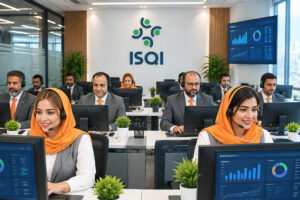


You may have experienced situations where you contact the customer support team of a large company and discover that the agent answering your call is actually working in a country completely different from where the company is headquartered or primarily operates. This phenomenon, known as Call Center Outsourcing, has been one of the most significant trends in the customer service industry over the past few decades. But what exactly is outsourcing, why do companies rely on it, and what is the experience like for someone working in an outsourced call center? This article explores these questions.
What Is call center Outsourcing and Why Has It Become So Common?
Outsourcing means transferring a part of a company’s operations—in this case, customer service or telephone sales—to another independent company or team, often in a country with lower labor costs.
Instead of hiring and managing hundreds of agents internally, a large company may contract a specialized call center provider to handle these activities on its behalf.
The primary reason for the popularity of this model is cost efficiency. The cost of hiring and retaining employees can be significantly lower in some countries than in developed economies.
Countries such as the Philippines, India, and South Africa have become major hubs for the industry due to their large English-speaking populations and competitive labor costs.
By outsourcing these activities, companies can reduce their operating expenses and allocate the resources they save to other areas, such as product development and business growth.
Two Main Types of Call Centers: Inbound and Outbound
To better understand the experience of working in an outsourced call center, it is useful to distinguish between the two main types of call center operations.
1 – 1 – Inbound Call Centers
In this model, agents handle calls initiated by customers, such as requests for technical support, order tracking, or complaints.
In these environments, service quality is often continuously monitored by Quality Analysts. Calls may be recorded and reviewed to ensure that agents follow the company’s procedures, communication standards, and service requirements.
1 – 2 – Outbound Call Centers
In this model, agents initiate calls to customers for purposes such as sales, surveys, or follow-ups.
Outbound interactions are often guided by predefined scripts that specify how the conversation should begin, how potential customer objections should be handled, and how the call should be concluded.
Outbound calling, particularly in telemarketing, is also subject to strict regulations in many countries. For example, contacting telephone numbers registered on a Do Not Call list may be prohibited and can result in penalties in certain jurisdictions.
What Is Different About Working in an Outsourced Call Center?
From an agent’s perspective, working in an outsourced call center can differ significantly from working in an internal or in-house operation.
- Stricter Performance Standards: Because the client company often closely monitors the quality of outsourced services, performance requirements in outsourced centers may be more detailed and demanding.
- Need for Cultural Adaptation: Agents may need to adapt to the culture, accent, communication style, or even everyday expressions of the customers’ country so that interactions feel more natural and comfortable.
- Different Working Hours: Due to time-zone differences, many agents working in outsourced centers may have to work night shifts or non-standard hours to align with the business hours of the client country.
- Pressure to Maintain International Standards: Because the parent company’s brand is directly exposed to customer perceptions, agents may face additional pressure to follow procedures precisely and avoid cultural misunderstandings.
Why Is This Job Still Attractive Despite the Challenges?
Despite these pressures, working in call centers—including outsourced operations—offers genuine advantages for many people, particularly those at the beginning of their careers.
- A Fast Entry Point into the Job Market: Unlike many professions, entering the call center industry often does not require extensive previous experience or a specialized degree. This makes it an attractive option for people looking for relatively quick employment.
- Competitive Compensation and Benefits: Many outsourced call centers, particularly those serving international brands, offer relatively attractive salaries and benefits compared with other entry-level jobs in their markets.
- Opportunities for Skill Development: Working in this environment can rapidly develop valuable skills such as effective communication, problem-solving, and customer management. These skills are transferable to many other professions.
- Career Advancement Opportunities: Many current call center supervisors and managers began their careers as agents. As a result, internal career progression within the industry can be a realistic and tangible opportunity.
Key Challenges That Should Not Be Overlooked
Alongside these opportunities, several important challenges exist in the call center outsourcing model that both employees and managers need to recognize.
- High Employee Turnover: Due to workload, performance pressure, and the repetitive nature of the job, many outsourced call centers experience high employee turnover, which increases recruitment and retraining costs.
- Intensive Monitoring and Supervision: Continuous call recording and detailed performance evaluations are often necessary to maintain service quality. However, they can also be stressful and exhausting for some employees.
- Legal and Regulatory Complexity: Particularly in outbound operations, agents must comply with the regulations of the target country, which may differ significantly from the laws of their own country. Understanding these requirements is essential to prevent legal problems for both employees and the organization.
Key Considerations for Organizations Managing Outsourced Call Centers
For outsourcing to genuinely benefit both the organization and its employees, several principles are important:
- Continuous Cultural and Language Training: Training should not be limited to the beginning of employment. Ongoing development helps agents remain aligned with cultural changes and evolving customer expectations.
- Clear Communication Between the Client Company and the Outsourced Team: The smaller the communication gap between the two sides, the easier it is to maintain alignment in objectives, processes, and service quality.
- Focus on Employee Well-Being and Motivation, Not Just Performance Numbers: Organizations that focus exclusively on quantitative metrics while overlooking employee well-being may eventually experience declining service quality.
Conclusion
Call center outsourcing represents a combination of opportunities and challenges for both organizations and employees.
On the one hand, outsourcing allows companies to reduce costs and focus on their core activities, while providing employees with opportunities for relatively quick entry into the job market and valuable skill development.
On the other hand, high performance pressure, intensive monitoring, and cultural and regulatory complexities present real challenges.
Ultimately, success in an outsourced call center model depends on achieving a balance between operational efficiency for the organization and genuine attention to the well-being and professional growth of the employees who serve as the primary voice of the brand to its customers every day.
Author: Zahra Shirband – International Relations Expert ISQI
Source: Work Habits and Performance Factors in Call Center Agents: Insights from a Literature Review (DOI: 10.47760/cognizance.2025.v05i02.001)