
In the first part of this series, we introduced the operating principles of the Electronic Stability Control (ESC) system, its main components, the sensors it employs, and the way it intervenes to maintain vehicle stability. However, the proper performance of a control system cannot be ensured solely through sound design; it must also be evaluated under real-world driving conditions and critical maneuvers.
For this reason, international standards define a set of dynamic test procedures to assess ESC performance. These tests enable engineers to evaluate vehicle stability, the intervention strategy of the ESC system, and its ability to prevent loss of vehicle control under various driving conditions.
This article introduces the most important standardized tests used in the automotive industry—including the Sine with Dwell, Double Lane Change, Fishhook, and J-Turn tests—and examines the role of each in evaluating the performance of the Electronic Stability Control system.
Standards and Test Methods for ESC Performance Evaluation
After the Electronic Stability Control system has been designed and calibrated, its performance must be evaluated under both real-world and critical driving conditions. In addition to satisfying regulatory requirements, these evaluations play a vital role in the development, validation, and optimization of vehicle control algorithms. Dynamic testing enables engineers to investigate vehicle behavior, the intervention of the ESC system, and its ability to maintain stability under repeatable and controlled conditions.
The principal regulations and standardized methods used to evaluate ESC performance and vehicle dynamic behavior include:
- FMVSS No. 126 (United States)
- UNECE Regulation No. 140 (UNECE member countries)
- ISO 3888-1:2018 and ISO 3888-2 (standards for the Double Lane Change and Obstacle Avoidance maneuvers)
It should be noted that ISO 3888 is not an ESC-specific standard. Instead, it defines the standardized procedure for conducting the Double Lane Change (DLC) or obstacle avoidance maneuver. The standard is widely used in vehicle development, ESC tuning and calibration, and the evaluation of vehicle dynamic behavior. In contrast, FMVSS No. 126 and UNECE Regulation No. 140 specify the functional requirements and regulatory performance criteria for ESC systems, which manufacturers must satisfy to obtain vehicle type approval and market authorization.
Major ESC Performance Evaluation Tests
- Sine with Dwell Test
Test Overview
The Sine with Dwell test is considered the most important functional test for Electronic Stability Control under FMVSS No. 126 and serves as the primary criterion for ESC compliance in the United States.
The objective of this test is to evaluate the ability of the ESC system to prevent excessive vehicle yaw rate and maintain stability during a severe and sudden steering maneuver.
Test Procedure
During the test, the vehicle travels in a straight line at a specified speed, typically around 80 km/h.
A steering robot then applies a predefined steering input consisting of three stages:
- A sinusoidal increase in steering-wheel angle.
- Holding the steering angle constant for a short period (the dwell phase).
- Rapidly returning the steering wheel to its initial position.
The use of a steering robot ensures that every test is conducted with identical steering angle, timing, and steering rate, thereby providing excellent repeatability and consistency.
Measured Parameters
During the test, numerous parameters are recorded and analyzed, including:
- Vehicle yaw rate
- Lateral acceleration
- Vehicle speed
- Steering-wheel angle
- Sideslip angle (or its estimated value)
- ESC activation status
- Engine torque reduction
- Brake hydraulic pressure or brake intervention level
According to FMVSS No. 126, after completion of the maneuver, the vehicle must control its yaw rate within specified limits and return to a stable condition. The regulation defines acceptable yaw-rate decay limits at specified times following the completion of the steering maneuver.
Importance of the Test
This test represents the most significant benchmark for evaluating the performance of ESC control algorithms because it simulates a real-world emergency situation in which a driver rapidly steers to avoid an unexpected obstacle and then quickly returns the vehicle to its original path.
- Double Lane Change Test (ISO 3888)
Test Overview
The Double Lane Change (DLC) test, commonly known as the Moose Test, is defined by ISO 3888-1 and ISO 3888-2.
The test simulates a sudden obstacle avoidance scenario—such as avoiding an animal, another vehicle, or a pedestrian—and evaluates the vehicle’s ability to perform a rapid lane change and safely return to its original lane.
Although the Double Lane Change test is not a mandatory requirement of FMVSS No. 126, it is widely regarded as one of the most important development and validation maneuvers in the automotive industry.
Test Procedure
In this test, the course is defined using traffic cones, and the vehicle is required to:
- Enter the adjacent lane.
- Navigate through the course without striking any cones.
- Return safely to the original lane.
The vehicle speed is gradually increased until the maximum speed at which the maneuver can be completed without loss of control is determined.
Evaluation Parameters
The following parameters are typically evaluated during the test:
- Vehicle stability
- Understeer behavior
- Oversteer behavior
- Yaw rate
- Lateral acceleration
- ESC intervention level
- Sideslip angle
- Contact with or avoidance of the traffic cones
When the ESC system performs effectively, the vehicle should be able to complete the maneuver with minimal sideslip and without entering an uncontrollable spin.
3. Fishhook Test
Test Overview
The Fishhook test is one of the most severe dynamic maneuvers used in the automotive industry and is primarily designed to evaluate a vehicle’s rollover resistance.
The test was originally developed by the National Highway Traffic Safety Administration (NHTSA) to investigate the behavior of sport utility vehicles (SUVs) and pickup trucks, which are generally more susceptible to rollover because of their higher center of gravity.
Although the Fishhook test is not an ESC-specific regulatory test, it provides an effective means of assessing the performance of the Electronic Stability Control system during highly demanding vehicle maneuvers.
Test Procedure
During the test, the vehicle travels at a specified speed while a steering robot performs the following sequence:
- Rapidly turns the steering wheel in one direction.
- Immediately reverses the steering input at the same steering rate toward the opposite direction.
This maneuver generates very high lateral acceleration and rapid load transfer between the vehicle’s wheels.
Test Objectives
The Fishhook test evaluates the following:
- Wheel lift tendency
- Rollover potential
- Lateral load transfer
- ESC performance
- Roll Stability Control (RSC) performance (if equipped)
- Engine torque reduction
- Selective braking performance
When the ESC system functions properly, selective brake intervention combined with engine torque reduction can prevent instability from escalating and significantly reduce the likelihood of rollover. Nevertheless, under extremely severe conditions, no control system can overcome the fundamental physical limits of the vehicle.
4. J-Turn Test
Test Overview
The J-Turn test is a commonly used vehicle development maneuver for evaluating vehicle behavior during constant-radius cornering.
It is primarily employed during the tuning of the steering system, suspension system, and ESC calibration, and it is not one of the mandatory test procedures specified in FMVSS No. 126.
Test Procedure
In this test, the vehicle enters a corner with a constant radius while its speed is gradually increased.
As the speed increases, engineers evaluate the vehicle’s understeer and oversteer characteristics, together with the timing and effectiveness of ESC intervention.
Measured Parameters
The following parameters are typically recorded during the test:
- Lateral acceleration
- Yaw rate
- Vehicle speed
- Steering-wheel angle
- Sideslip angle
- ESC intervention level
- Engine torque
- Brake system pressure
The J-Turn test provides valuable information regarding vehicle stability during sustained cornering and the performance of the ESC system when the tires are operating near their adhesion limits.
Why Is a Steering Robot Essential for These Tests?
All of the tests described above require an exceptionally high level of repeatability. Even minor variations in steering angle, steering rate, or maneuver timing can significantly influence the test results. Consequently, human drivers cannot consistently achieve the precision and repeatability required for standardized vehicle testing.
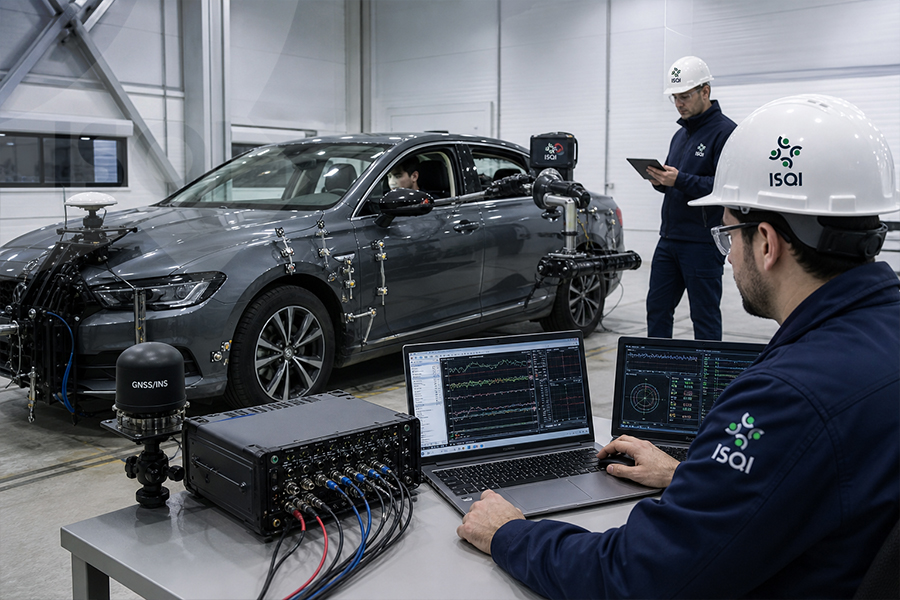
For this reason, accredited proving grounds and automotive manufacturers employ steering robots. These systems can reproduce predefined steering profiles with extremely high accuracy, precisely controlled steering rates, and complete repeatability. The use of steering robots ensures that test results are independent of driver skill, enabling objective comparison of different vehicles and control systems.
Conclusion
Dynamic testing is an indispensable part of the development and validation process for Electronic Stability Control systems. Regulations such as FMVSS No. 126 and UNECE Regulation No. 140 establish the performance requirements for ESC, while maneuvers such as the Sine with Dwell, Double Lane Change, Fishhook, and J-Turn tests enable detailed evaluation of vehicle behavior under critical driving conditions.
Reliable execution of these tests depends on fully repeatable test conditions and highly accurate measurement of vehicle dynamic parameters. Consequently, advanced measurement equipment, data acquisition systems, and vehicle control robots play a fundamental role in ESC performance evaluation.
In Part III of this series, we will introduce the principal equipment used in ESC testing—including INS/GNSS systems, steering robots, pedal robots, data acquisition (DAQ) systems, and CAN bus analysis tools—and discuss how each contributes to the accurate evaluation of Electronic Stability Control performance.
Author: Zahra Shirband – International Relations Expert ISQI
References
- National Highway Traffic Safety Administration (NHTSA). Federal Motor Vehicle Safety Standard No. 126: Electronic Stability Control Systems. U.S. Department of Transportation. Available at: https://www.nhtsa.gov (Accessed August 2, 2026).
- United Nations Economic Commission for Europe (UNECE). UN Regulation No. 140: Uniform Provisions Concerning the Approval of Passenger Cars with Regard to Electronic Stability Control (ESC) Systems. Geneva, Switzerland. Available at: https://unece.org (Accessed August 2, 2026).
- International Organization for Standardization (ISO). ISO 3888-1:2018, Passenger Cars—Test Track for a Severe Lane-Change Manoeuvre—Part 1: Double Lane-Change. Geneva, Switzerland: ISO, 2018.
- Rajamani, R. Vehicle Dynamics and Control, 2nd ed. New York, NY, USA: Springer, 2012.
- Gillespie, T. D. Fundamentals of Vehicle Dynamics. Warrendale, PA, USA: SAE International, 1992.