

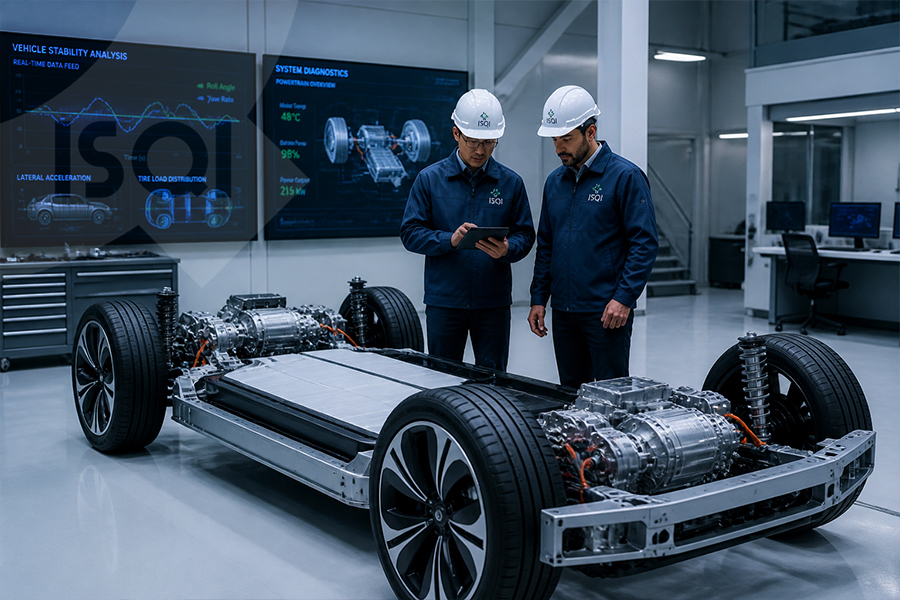
Modern vehicles are no longer just means of transportation—they have evolved into intelligent systems capable of making decisions faster and more accurately than human drivers in many situations. One of the most important of these technologies is the Electronic Stability Control (ESC) system, which can prevent skidding, loss of control, and even rollovers within fractions of a second.
With the emergence of the new generation of electric vehicles, however, new opportunities have arisen to make these systems even smarter.
Why Do Electric Vehicles Need Smarter Stability Control?
Imagine driving at high speed on a wet or snowy road when you suddenly have to steer around an obstacle. Under such conditions, the vehicle may rotate excessively, understeer, oversteer, or even leave the roadway. Preventing these situations is the primary responsibility of the vehicle stability control system.
In conventional electric vehicles, a single electric motor delivers power to the wheels through a differential. In Distributed Drive Electric Vehicles (DDEVs), however, each wheel is powered by its own independent electric motor. This architecture enables the control system to regulate the torque of each wheel individually within milliseconds, allowing much more precise vehicle control during cornering and emergency maneuvers.
In this study, researchers exploited this capability to develop an intelligent stability control system by combining two well-established engineering approaches: Sliding Mode Control (SMC) and Fuzzy Logic.
Two Key Indicators of Vehicle Stability
Engineers generally evaluate vehicle stability using two primary parameters:
- Yaw Rate: The rotational speed of the vehicle about its vertical axis.
- Sideslip Angle: The difference between the direction the vehicle is pointing and the direction in which it is actually moving. A larger sideslip angle indicates greater tire slip on the road surface.
Most conventional stability control systems assign fixed weighting factors to these two variables. The problem is that their relative importance changes under different driving conditions.
For example, on a dry road at low speed, controlling the yaw rate is generally more important. On slippery roads at higher speeds, however, controlling the sideslip angle becomes significantly more critical.
Using constant weighting factors therefore limits the system’s ability to adapt to real-world driving conditions.
The Solution: A “Fuzzy Brain” for Real-Time Decision-Making
The primary innovation of this research is the development of an intelligent controller capable of dynamically adjusting the relative importance of yaw rate and sideslip angle in real time.
This decision-making process is based on Fuzzy Logic, which mimics human reasoning rather than relying solely on rigid mathematical rules.
For example:
- If the sideslip angle is large while the yaw rate remains relatively small, the controller prioritizes reducing vehicle sideslip.
- If both values remain small, the vehicle is considered stable and no significant intervention is required.
The output of the fuzzy logic module is an adaptive weighting factor that is supplied to the Sliding Mode Controller.
The sliding mode controller continuously calculates the vehicle’s deviation from its desired state and generates the corrective yaw moment required to return the vehicle to the intended path.
Four Wheels, Four Independent Decisions
Generating the corrective yaw moment is only part of the challenge. The more critical task is distributing that corrective torque among the four-wheel motors.
To accomplish this, the researchers employed a Quadratic Programming (QP) optimization algorithm.
This algorithm distributes torque among the four motors so that no individual tire exceeds its available grip, thereby minimizing the likelihood of wheel slip.
The optimization also considers real-world vehicle constraints, including:
- Maximum electric motor torque
- Tire-road friction coefficient
- Vehicle operating limits
Testing Under Extreme Conditions
To evaluate the proposed controller, simulations were conducted using the professional vehicle simulation platforms CarSim and MATLAB/Simulink.
Two demanding driving scenarios were selected:
- A high-amplitude sinusoidal steering maneuver, representing rapid successive cornering.
- The standardized Double Lane Change maneuver, designed to simulate sudden obstacle avoidance.
Both tests were performed at 100 km/h on a low-friction surface representative of wet or snowy roads.
What Did the Results Show?
The proposed controller demonstrated substantial improvements:
- Compared with an uncontrolled vehicle, yaw rate was reduced by approximately 50%, while sideslip angle decreased by nearly 80%.
- Compared with conventional Sliding Mode Control, the proposed approach still performed better, achieving more than 39% improvement in sideslip angle control under certain conditions.
- Vehicle longitudinal speed remained nearly unchanged, indicating that safety improvements were achieved without significantly sacrificing vehicle performance.
Beyond Computer Simulation
To verify the practical feasibility of the proposed approach, the researchers did not rely solely on software simulations.
Instead, they implemented the control algorithm on a real electronic controller connected to a vehicle simulation platform using a Hardware-in-the-Loop (HIL) testing environment.
The HIL test results differed by less than 5% from the software simulation results, demonstrating that the proposed controller is suitable for implementation in real vehicle control systems.
Why Is This Research Important?
As electric vehicles equipped with independently driven wheels become increasingly common, precise wheel torque control is no longer merely a laboratory concept—it is gradually becoming a core technology of future automobiles.
This study demonstrates that combining classical control engineering techniques, such as Sliding Mode Control, with simple yet highly effective artificial intelligence methods like Fuzzy Logic can make vehicles safer, smarter, and more reliable under critical driving conditions, without requiring complex hardware or computationally intensive machine learning models.
Ultimately, the future of vehicle safety may depend not only on engine power or braking performance, but also on intelligent control algorithms capable of making better decisions than a human driver within just a few milliseconds.
Author: Zahra Shirband – International Relations Expert ISQI
Source:
Stability Control of Distributed Drive Electric Vehicle Based on Adaptive Fuzzy Sliding Mode
DOI: 10.1177/09544070231169804