

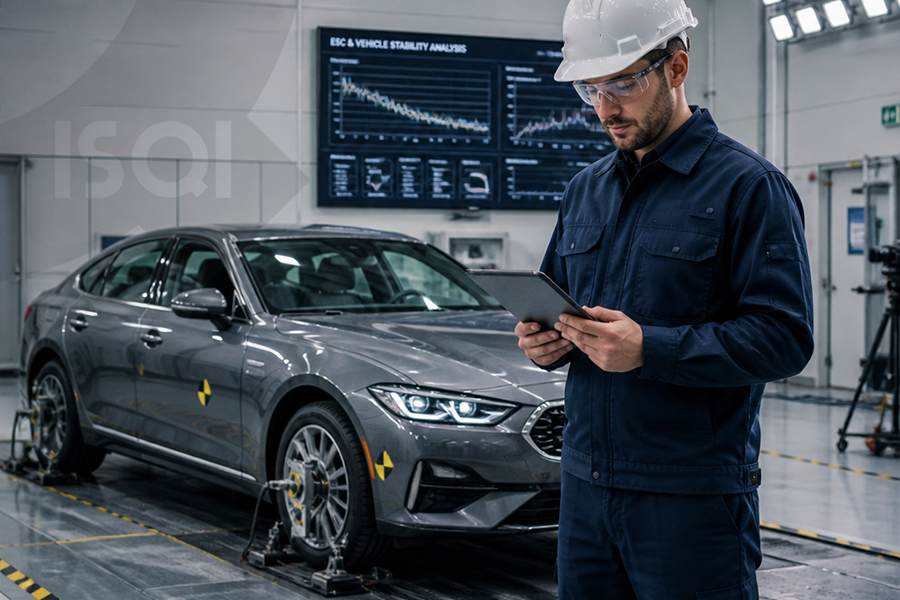
If you have ever seen a vehicle suddenly lose control and move left or right on a slippery road or during a sharp turn, you understand that stability is one of the most important concerns in driving safety. Electronic Stability Control (ESC) systems are specifically designed for this purpose: helping vehicles maintain the driver’s intended path under challenging conditions such as wet or snowy roads and sudden cornering, while preventing skidding or uncontrolled rotation.
In conventional vehicles, this function is typically achieved by applying individual braking forces to each of the four wheels. However, a new generation of electric vehicles uses a different architecture in which, instead of a central motor, each wheel has its own independent electric motor. These motors are installed directly inside the wheel space and are therefore called In-Wheel Motors.
Such a vehicle, where all four wheels are independently driven by separate motors, is referred to in technical literature as a Four In-Wheel Motor Drive Electric Vehicle (4MIDEV).
Why Are In-Wheel Motors Attractive?
This design offers several important advantages:
- There is no need for a differential, gearbox, or complex power transmission system because each wheel has its own motor.
- The torque of each wheel can be adjusted extremely quickly and precisely because commands are sent directly to the motor of that specific wheel.
- During braking, instead of losing kinetic energy as heat like conventional braking systems, part of the vehicle’s energy can be recovered and returned to the battery. This process is known as regenerative braking.
However, this high level of control freedom also introduces a new challenge: four independent motors must be controlled and coordinated simultaneously to maintain vehicle stability.
This is where the Electronic Stability Control system becomes essential.
How Does the Electronic Stability Control System Work?
In simple terms, the ESC system consists of three main stages that work together as a decision-making chain:
1. Stability Condition Detection
The first part acts like a “guardian.” It continuously monitors information such as steering angle, wheel speeds, vehicle acceleration, and most importantly, the vehicle’s sideslip angle.
The sideslip angle indicates how much the vehicle body deviates from its actual direction of travel. The larger this angle becomes, the closer the vehicle is to losing control.
If this monitoring system detects that the vehicle has moved away from normal operating conditions, it activates the stability control mode.
2. Determining the Desired Vehicle Behavior
Once the stability control mode is activated, the system must determine how the vehicle should behave at that moment.
Based on vehicle speed and steering angle, this part calculates the ideal vehicle rotation rate (Yaw Rate) and the desired sideslip angle.
The ideal values are then compared with the actual vehicle behavior. If a significant difference is detected, the system determines how much corrective yaw moment is required to return the vehicle to the desired path.
3. Torque Distribution Between the Four Motors
This is the stage where the final decision is made: how much driving torque or regenerative braking torque should each of the four motors generate.
For example, assume the vehicle is turning left but rotates more than expected, a condition known as oversteer. In this situation, the system can reduce the torque of the inner-side motors or apply regenerative braking on those wheels to help return the vehicle toward a more stable trajectory.
The opposite condition can also occur, where the vehicle does not rotate enough, known as understeer.
Torque Distribution Methods Investigated in the Research
The study examined and compared three different torque distribution strategies:
- Simple and Uniform Method
In this method, the corrective torque is distributed equally among all wheels.
Although this approach is simple, it does not consider the actual condition of each wheel, such as how much vehicle load is acting on that wheel.
- Wheel Load-Based Method
During cornering or severe braking, vehicle weight is not distributed equally among all wheels.
This method assigns more torque to wheels that have greater load and available tire grip at that moment, reducing the possibility of slipping on lighter-loaded wheels.
- Optimal Method
This is the most complex and accurate approach.
Through mathematical optimization, the system determines the best possible combination of torque values for all four wheels. The objective is to provide the required forces for both vehicle movement and rotation while ensuring that none of the tires reaches the limit of adhesion.
What Were the Results?
To evaluate the system, researchers implemented it on a highly accurate vehicle simulation model and tested three common vehicle safety maneuvers:
- Single lane change
- Double lane change (similar to a sudden obstacle avoidance maneuver)
- Slalom maneuver
All tests were performed on a slippery road surface.
The results showed that without stability control, the vehicle completely lost control during these maneuvers, and its actual trajectory deviated significantly from the driver’s intended path.
However, when the stability control system was activated, especially with the optimal torque distribution method, the vehicle followed the desired trajectory with significantly higher accuracy.
On average, the vehicle’s yaw tracking error was reduced by approximately 75% compared with the uncontrolled condition. This result demonstrates that such a system can create a real and noticeable improvement in driving safety.
Conclusion
With the expansion of electric vehicles, especially new architectures based on in-wheel motors, stability control is no longer limited to intelligent braking. Instead, it has evolved into a precise, real-time coordination system between four independent electric motors.
This coordination can significantly improve vehicle safety under critical driving conditions. At the same time, by utilizing regenerative braking, it can recover part of the energy that would normally be lost in conventional vehicles.
The combination of enhanced safety and improved energy efficiency represents one of the key technologies shaping the future of electric vehicles.
Author: Zahra Shirband – International Relations Expert ISQI
Reference
Electronic Stability Control Based on Motor Driving and Braking Torque Distribution for a Four In-Wheel Motor Drive Electric Vehicle
DOI: 10.1109/TVT.2016.2526663